Set Up National Moral & Integrity Council web

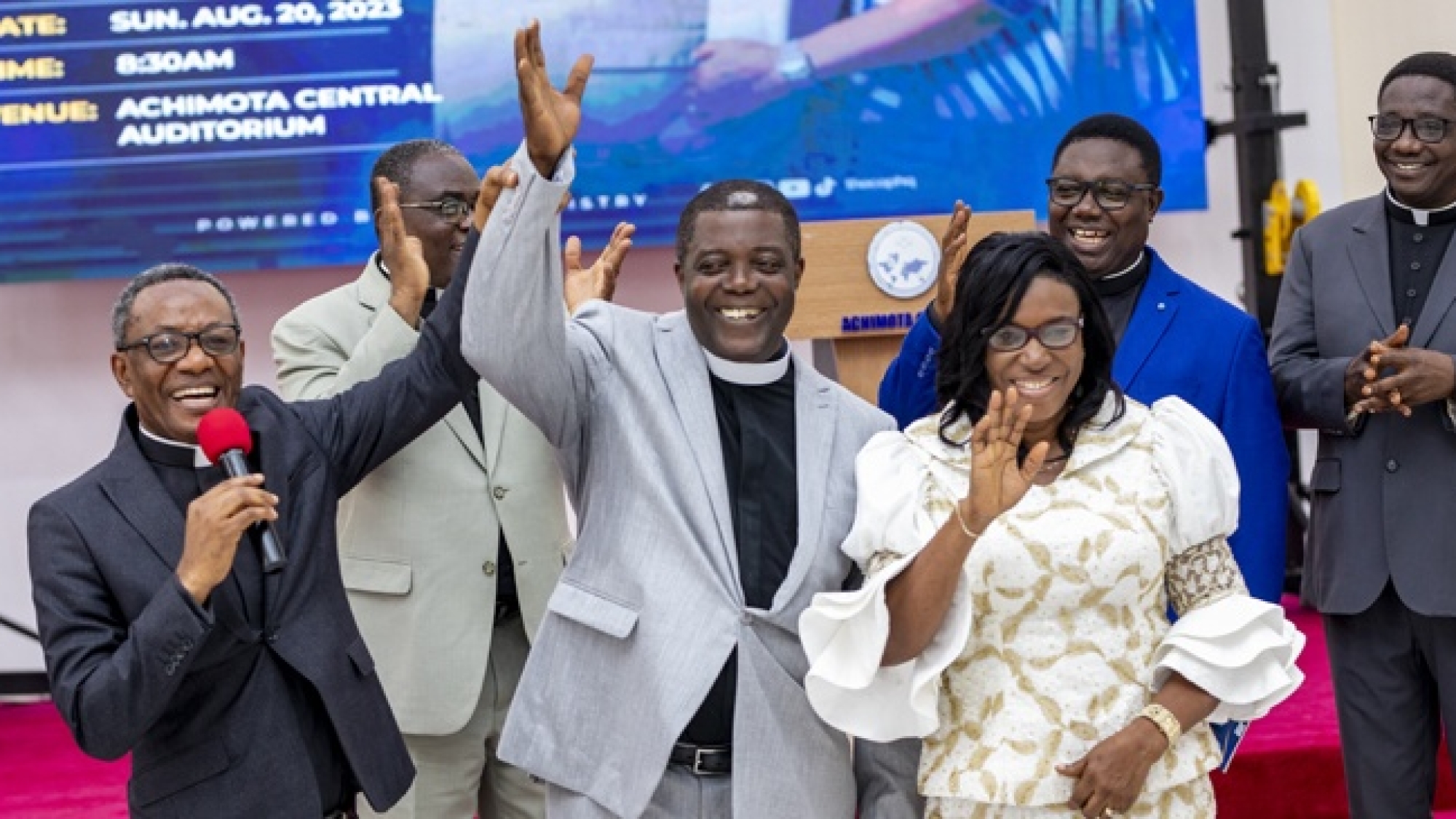
The two-day National Development Conference 2023 on “Moral Vision and National Development” has ended with a unanimous call by participants for a National Moral and Integrity Council akin to the National Peace Council to be instituted to develop a Moral Vision Plan to inform Ghana’s development agenda for the next generation.

The Council, when established, will lead the restoration of generations of decay and moral decadence that Ghana has experienced over the years.

The Conference also recommended the setting up of a multi-faceted electoral team facilitated by Faith-Based Organisations to continuously engage with the National Commission for Civic Education (NCCE), the Commission for Human Rights and Administrative Justice (CHRAJ) to see to fruition the National Moral Vision Plan.  

These calls were contained in a communique issued at the end of the conference, which brought together over 2000 stakeholders drawn from a broad spectrum of Ghanaian society (religious groups, traditional authorities, political parties, media, professional bodies, Civil Society Organisations, the Clergy among others) at the Pentecost Convention Centre, Gomoa Fetteh near Kasoa.

Delivering his closing remarks, Apostle Eric Nyamekye, Chairman of The Church of Pentecost, expressed his belief that the conference’s outcome will be a watershed for moral, ethical and sound re-awakening for Ghanaians and Africa.

The participants of the conference concluded that the nation’s moral fibre had dipped very fast, and the voice of non-political actors, including the religious organisation, had not been audible enough. It further noted the urgent need for leaders with a moral conscience to carry the leadership mandate in an honest manner in all spheres of Ghanaian society.

The conference, which saw participants breaking into plenary sessions to discuss various thematic areas, had the Vice President, Dr. Mahmoud Bawumia, delivering the keynote address.

Also in attendance to deliver fraternal greetings was the Speaker of Parliament, Rt. Hon. A.S.K. Bagbin, the Chief Justice, Her Ladyship Gertrude Torkonoo, Former Presidents John Agyekum Kufuor and John Dramani Mahama and President of the Ghana Journalist Association, Mr. Albert K. Dwumfuor among other distinguished guests.

Speakers at the conference presented papers on thought-provoking and insightful topics on the gross decline of the moral fibre of society and its consequences for future generations.

They also proffered significant solutions and recommendations on the issues they raised. The Voice of Pentecost were in attendance and interspersed the deliveries with renditions of national and patriotic songs of Ghana.

Find below a copy of the communique.

Religion Plays A Significant Role In Nation Building web

Religion Plays A Significant Role In Nation Building – Sheikh Shaibu Asserts

Sheikh Aremeyaw Shaibu, the Spokesperson of the National Chief Imam, has emphasised the significant role of religion in upholding moral uprightness for national development.

According to the respected religious scholar, religion and morality are inseparably intertwined, with religious norms shaping and governing behaviour to achieve moral goals.

Presenting a paper on the topic, “Religion, Morality and National Development,” yesterday at the maiden National Development Conference held at Pentecost Convention Centre (PCC), Sheikh Shaibu highlighted that the choice of the vision of the conference could not have been done at a better time.

He expressed concern about the moral heritage that the current generation of Ghanaians aims to pass on to future generations.

Defining morality as a system society uses to determine right from wrong, he noted that it involves a code of conduct that guides individuals to engage in behaviours deemed good and encouraged while discouraging harmful actions (moral vices).

Morality, at its core, he explained, pertains to the purity of thoughts that influence actions and their consequences on both individuals’ and society’s welfare.

The scholar elaborated on the observable characteristics of religion within communities, such as beliefs, places of worship, rituals, sacred symbols, holy texts, moral quotes, prayers, invocations, feasts, and festivals.

He noted that religion manifests in two forms: the belief and faith aspect, which is the core, and the other elements that form the expression of religion.

However, Sheikh Shaibu lamented that Ghana sometimes focuses too much on the external aspects of religion, neglecting its core essence, leading to a disconnection between faith and practice.

He pointed out that despite the dominance of religion, morality is on a steady decline in Ghanaian society, posing a challenge to address moral decadence.

“Throughout history, religion has provided moral quotes that form the basis of modern society’s laws, encouraging righteousness and social harmony,” he said.

He stressed that religion without morality is devoid of substance and unproductive, underscoring the need to uphold and honour morality as it uplifts and supports society, transforming individuals into agents of lasting and enduring development and moral integrity.

Regarding the relationship between religion and development, Sheikh Shaibu emphasised that the key to meaningful and sustainable development lies in the moral progress and happiness of the citizenry.

“Moral development is essential for national development, as a morally undeveloped and apathetic citizenry hinders the country’s progress,” he admonished.

Concluding his presentation, Sheikh Aremeyaw Shaibu urged society to recognise the indispensable role of religion in fostering moral uprightness, promoting ethical reflection, and guiding individuals toward meaningful development.

PENTECOST NEWS.

Sustain & Intensify Fight Against Galamsey web

Sustain & Intensify Fight Against Galamsey- Hon. Affenyi Ddzie Urges Media

A former Member of the Council of State, Hon. Mrs. Gifty Affenyi Dadzie, has called on the media to sustain the media campaign in the fight against the illegal mining (galamsey) menace while demonstrating positive defiance against the influential individuals behind the menace in their reportage.

While commending the media in Ghana for the significant contribution and progressive landmarks in national development and the fight against ‘galamsey’, she quickly revealed that available information suggests that some influential individuals were behind the menace and stood to gain at the state’s expense.

“The beneficiaries of ‘galamsey’ are powerful and would not easily give up irrespective of the dangers to our water bodies and environment,” he stressed.

Giving a synopsis of the cost involved in treating water for use and the future implications on the country, she reiterated and passionately appealed to the media to keep the pressure and sustain their campaign against the menace in the interest of future generations.

She further indicated that the gross disregard by persons involved in the menace pointed to the gory state of the moral conscience in the country today and reflected an existential threat to the environment and livelihood.

Delivering a paper on the second day of the two-day National Development Conference organised by The Church of Pentecost at the Pentecost Convention Centre (PCC), Gomoa near Kasoa, on the theme “Moral Vision and National Development: The Role of the Media,” Mrs. Afenyi Dadzie, who is also the National Prayer Director for Aglow International, called on Church leaders in Ghana to also preach/teach on morality and responsible citizenship to the congregants, especially in the face of the current predicament facing the nation.

She opined that the Church must engage with the media and other stakeholders in shaping the moral vision and national development since any compartmentation will not affect the country’s interest, especially the future generation.

The former Ghana Journalist Association (GJA) President also decried some excesses perpetrated by some persons against media practitioners in discharging their duties. She was, however, quick to add that the media also has a responsibility to ensure that their reportage is always in line with the mandate of accountability and watchdog role.

“The media should not downplay the role and importance of rejoinders in the journalistic work but take cognisance of the Article 62 of the 1992 Constitution,” she advised.

Touching on corruption and its tendencies in the media, she called on the GJA, NMC and others in the media regulatory space to advocate for a reasonable compensation regime for practitioners since there are currently ‘some very poor salaries,” citing a study by the School of Communication Studies of the University of Ghana to validate her assertion.

PENTECOST NEWS.

God Doesn’t Support Irresponsibility web

God Doesn’t Support Irresponsibility – Prof. Adadevoh Tells Africans

The Founder and President of the International Leadership Foundation (ILF), Prof. Delanyo Adadevoh, has challenged Africans to take responsibility for their own development because God does not support irresponsibility. 

The professor who doubles as the Global Vice-President for Campus Crusade for Christ made the call when he addressed participants on the second day of the National Development Conference (NADEC’23) at the Pentecost Convention Centre (PCC), Gomoa Fetteh, under the theme “Moral Vision and National Development.”

In an address that centred on the subthemes of integrity, freedom and justice, interdependence, maximisation and excellence, Prof. Adadevoh said being responsible for one’s self and development required a high level of integrity.

He pointed out that the private life of a person of integrity is always consistent with their public life. He iterated that a nation with low integrity cannot develop.

“Without integrity, every effort is like filling a huge barrel with holes with water; the more you fill it, the more it spills out,” he added.

He observed that corruption has become so endemic in Africa that it sometimes looks impossible to uproot.

“You know corruption is systemic when those who need to fight it are also corrupt,” he stated.

He indicated that one way corruption had been made attractive was by missing the context and philosophy in the folk tales of the Ananse stories.

He, therefore, proposed that the context of “Ananse stories” should be reset to lead the citizenry into integrity and not emulate the corrupt ways of Ananse.

Prof. Adadevoh also called on the Ghanaians to take up the responsibility of ensuring that they experience true freedom by becoming sincere advocates of justice for the people.

He further opined that when freedom is granted by another, then it could be taken back by the one who granted it, but when one fights for their own freedom, they become truly free.

“We should move into the space of victory; it is about time we took our freedom and fought for justice for others,” he encouraged.

He also charged Ghanaians to consider value addition in order to maximise whatever God has given and endowed the nation.

Referencing Matthew 25:15, he noted that whoever God gives a resource, He also grants abilities to manage same. Thus, he indicated that no one should think Africans, and for that matter, Ghanaians are incapable of managing their resources.

‘The reason we haven’t done better is because our country is exporting huge timber logs and importing toothpicks! You cannot develop in this way,” he lamented.

 He said underlining the first request of ‘give us our daily bread’ in the Lord’s prayer is what one has, further stressing the significance for Ghanaians to focus on value addition to the natural resources at their disposal.

He said the greatest havoc on Africa is that the West robbed her of all that was hers and imposed theirs on Africa.

“Your ‘Abolo’ [bread] is based on maize that you have, but the ‘Yevu bolo’ [Whiteman’s bread] is from wheat that you don’t have. And we have developed a taste for what we don’t have. This is how we lost our ground,” he said.

He observed further that as long as the dependency syndrome prevailed in the minds of Ghanaians, the nation would continue to be beggars, which would continue to affect the nation’s development agenda.

He stated that ‘daily bread’ is a measure of our existence and growth. ‘If you win the battle in the space of “daily bread,” you can develop. But I can tell you categorically that we are losing it,” he stated, adding that ‘God requires what is in your hand before He multiples it. If we don’t change and use what God gave to us for our daily bread then we are joking’.

PENTECOST NEWS.

Education Without Moral Values Is Perilous web

Education Without Moral Values Is Perilous – Dr. Opuni Frimpong Asserts

Rev. Kwabena Opuni Frimpong, the Chief Executive Officer (CEO) of the Alliance for Christian Advocacy and former General Secretary for the Christian Council of Ghana (ACAA), has called on the leaders of the country to pay critical attention to Ghana’s educational system in order to raise competent future leaders and avoid kakistocracy.

According to the Presbyterian minister, “Education without moral and spiritual values always produces intelligent criminals, and no matter how plentiful they are in the system, we cannot build a nation with them.”

Rev. Opuni Frimpong made this statement yesterday during his presentation on the topic: “Patriotism and National Development” at the National Development Conference 2023 (NADEC’23) held at the Pentecost Convention Centre (PCC), Gomoa Fetteh.

During his presentation, Rev. Opuni Frimpong expressed concern about the moral decadence in Ghanaian society, especially in the conduct of students on various campuses, saying that education, particularly Christian education, must produce faithful disciples and good citizens in order to transform the world.

He cited various incidents that had gone viral to highlight the declining morality rate in schools and emphasised that leaders must not look unconcerned.

Rev. Opuni Frimpong partly attributed this growing concern to the two major political parties, the New Patriotic Party (NPP) and the National Democratic Congress (NDC), who have been steering the affairs of the nation for most of the 4th republic and called for a paradigm shift for national development.

He stated that the absence of a strong sense of morality and ethical values in the public space has also resulted in a kakistocracy, where the least competent persons are placed in leadership positions.

“There are too many ‘kakis’ in our political discourse. Unfortunately, the two major political parties in the country are the same and need to be nurtured,” he remarked.

Quoting Proverbs 13:22, he advised national leaders to rise to the task of leadership by leaving behind a great legacy for future generations and not creating problems for posterity to solve.

“It is only wicked people who create problems for their children to solve tomorrow,” he said.

PENTECOST NEWS.

Let’s Live For The Future! web

Let’s Live For The Future! – Apostle Nyamekye Tells Ghanaians

The Chairman of The Church of Pentecost, Apostle Eric Nyamekye, has challenged Ghanaians to be willing to endure discomfort by prioritising the interest of the nation ahead of their personal interests in order to hand over a better country to future generations.

According to him, the nation will not experience steady progressive growth if its citizens, particularly those in leadership positions, continue to promote their individual interests at the nation’s expense.

“We have people in leadership who only think about their interests, and this is not good. Live for the next generation and not just for the next four years,” Apostle Nyamekye charged, adding that “you cannot improve the future without addressing the present, so let us think about tomorrow’s Ghana. Whatever you do should benefit the nation.”

He made these remarks at the opening of a two-day National Development Conference, organised by The Church of Pentecost, at the Pentecost Convention Centre, Gomoa Fetteh, near Kasoa, on Wednesday, July 26, 2023. The theme of the conference is “Moral Vision and National Development.”

Drawing lessons from Isaiah 59:14-15 and Proverbs 14:34, he opined that every leader’s success or failure lies in the people’s nature, character, and confidence. He stressed the need to uphold moral principles since no nation can realise its potential with people who live by conflicting values.

Apostle Nyamekye cited the case of Moses, Israel’s greatest leader, who could not enter the Promised Land, and Aaron made a golden calf for the people, resulting in his inability to enter the promised land due to the character and pressure of the people, which they failed to nip in the bud promptly and strategically.

“We need to have a set of moral principles that will guide the life of Ghana. A socially approved and acceptable pattern and norms of proper conduct shared by all” advocated Apostle Nyamekye.

Apostle Nyamekye lamented the decline in moral values in Ghanaian society and highlighted the church’s transformative mandate and historical antecedents to be involved in the conversation of national development.

He encouraged the mindset to build a better world based on the teachings of our forebears about equality, the dignity of labour, and integrity in one’s words.

The conference, attended by a cross-section of Ghanaians from all parts of the country, including members of parliament, MMDCEs, political party representatives, assembly members, and others, is expected to issue a communique at its conclusion.

During the event, Vice President Dr. Mahamadu Bawumia delivered the keynote address, while former presidents H.E. John Agyekum Kufuor and H.E. John Dramani Mahama addressed the gathering.

Speeches and fraternal greetings were also delivered at the event by the Speaker of Parliament, Rt. Hon. Alban S. K. Bagbin, the Chief Justice, Her Ladyship Gertrude, Justice A. E. Torkonoo, and the President of the Ghana Journalist Association (GJA), Mr. Albert Kwabena Dwumfour.

The conference includes various topics, such as “Moral Vision and Development” by Prof. Delanyo Adadevoh of the International Leadership Foundation, “Leadership and Human Flourishing: Making a Case for Social Justice and Nation Building in Ghana Today” by Very Rev. Prof. J. Asamoah-Gyadu, President of Trinity Theological Seminary, and “Raising Effective Politicians for Africa” by Dr. Olivia N. Muchena, Former Minister of Women Affairs, Zimbabwe.

Other topics include “Religion and Morality Development” by Sheik Aremeyaw Shaibu, Spokesperson for the National Chief Imam, “Integrity in Nation Building” by Apostle A. N. Y. Kumi-Larbi, and “Patriotism and National Development” by Rev. Dr. Opuni Frimpong, Executive Director of Alliance for Christian Advocacy Africa.

PENTECOST NEWS.

Let Us Halt the Trend of Moral Decay Now web

Let Us Halt the Trend of Moral Decay Now – GJA President to Ghanaians

The President of the Ghana Journalist Association (GJA), Mr. Albert Kwabena Dwumfuor, has bemoaned the lack of commitment to arrest the decay of Ghana’s national fiber, resulting in a fast and alarming decline over the years. He, therefore, calls for urgent measures by all stakeholders to halt this trend, with a pledge to ensure the commitment of the media fraternity in Ghana to eliminate wrong practices within their fold and uphold the right moral attitude.

Mr. Dwumfuor made these remarks during a fraternal address at the two-day National Development Conference underway at the behest of The Church of Pentecost at the Pentecost Convention Centre, Gomoa Fetteh, near Kasoa.

Touching on the conference theme, “Moral Vision and National Development,” Mr. Dwumfuor indicated that given the role the Church has played in the country’s development, it would not be out of place to refer to it as the fifth estate of the realm, after the fourth estate, the media. He congratulated The Church of Pentecost for demonstrating that ‘the church is both faith and action.’

He emphasised that the fast decay of the country’s morals places an urgent responsibility on all stakeholders to rise and ensure corruption, injustice, and poverty are eradicated. ‘The Church must use its media and other platforms to speak on the ills of the nation without compromise,’ he said.

Mr. Dwumfuor encouraged the Church to take up its role as the centrepiece of development through active participation in the nation’s progress. He also admonished the media to partner with the Church in their mandate to expose corruption and rot in the nation.

He posited that the media needed the support of all who want to see the nation developed and corruption eradicated. ‘Even when the media gets it wrong, resorting to assault is not the way forward. We must refrain from attacking media practitioners,’ he observed.

He requested the executive arm of government and parliament to condemn, in no uncertain terms, all physical attacks on the media and the judiciary to severely punish perpetrators to serve as a deterrent.

He praised The Church of Pentecost for organising a monumental and historical conference focused on moral vision and national development. The conference, the first of its kind organised by the church, brings together politicians from the political divide in Ghana, policy analysts and think tanks, the academia, heads of public and private institutions, the media, and all stakeholders invested in charting a course for the development of the nation.

The two-day conference is expected to produce a blueprint for a harmonious national agenda, focusing on a moral vision that all stakeholders in the country will embrace.

The opening session of the conference was graced by the Vice President of the Republic, Dr. Alhaji Mahamudu Bawumia, the two surviving former presidents of Ghana, and their Excellencies, John Dramani Mahama and John Agyekum Kufuor. Also gracing the occasion are the Speaker of Ghana’s Parliament, Rt Hon. Alban Sumana Kingsford Bagbin; the Chief Justice of Ghana, Her Ladyship Gertrude Araba Esaaba Sackey Torkonoo; members of parliament, ministers, the President of the Central Regional House of Chiefs, Odeefo Amoakwa Buadu VIII, representing the President of the National House of Chiefs, Ogyeahohoo Yaw Gbebi II; the Spokesperson of the National Chief Imam, Sheih Aremeyaw Shaibu, among other dignitaries.

PENTECOST NEWS

Chiefs Are Significant Agents in National Development web

Chiefs Are Significant Agents in National Development – Odeefo Amoakwa Buadu III Avers

The President of the Central Regional House of Chiefs, Odeefo Amoakwa Buadu, has underscored the crucial role of traditional leaders in national development.

Odeefo Amoakwa Buadu, who is also the Paramount Chief of the Breman Traditional Area, made this statement today at the ongoing National Development Conference 2023 at the Pentecost Convention Centre (PCC), Gomoa Fetteh when he delivered fraternal greetings on behalf of the President of the National House of Chiefs.

In his address, the revered traditional ruler expressed that he deems his participation in the historic conference a great honour and commended The Church of Pentecost for strengthening the relationship between the Church and the Chieftaincy institution through various initiatives, including the introduction of the Chieftaincy Ministry.

He emphasised that chiefs play a significant role as development agents, mediating between people in power and their subordinates. Therefore, he called on the government, the Church, and other development stakeholders not to sideline the chiefs but to regard traditional rulers as development partners.

The National Development Conference 2023 was graced by the Vice President of the Republic of Ghana, Dr. Mahamadu Bawumia, along with many dignitaries, including former presidents John Agyekum Kufour, John Dramani Mahama, and many others.

PENTECOST NEWS.

Put Ghana First for National Development web

Put Ghana First for National Development – Speaker of Parliament Urges National Leaders

Right Honourable Alban Sumana Kingsford Bagbin, the Speaker of Parliament in Ghana, has called on national leaders and stakeholders in the development of the nation to prioritise Ghana’s interests above all else and work together without disparity.

“I strongly believe that Ghana can thrive again with our unwavering commitment and dedication to putting the nation first in all our endeavours. This confidence can pave the way for renewed commitment, ethical and moral leadership that fosters trust and confidence among citizens,” he asserted.

The Speaker of Parliament delivered this admonition on Wednesday, July 26, 2023, during the inaugural National Development Conference (NADEC) 2023, held at the Pentecost Convention Centre (PCC) in Gomoa Fetteh, near Kasoa.

Speaking on the theme, “Moral Vision and National Development: The Role of Ghana’s Politician,” he emphasised that the interplay between morality, the church, and politics plays a crucial role in national development.

“The state and the church are both morally obligated to maintain a harmonious relationship and equilibrium that holds nations together. The convergence of moral vision, national development, and the conduct of leadership, particularly political leadership, are vital for Ghana’s development,” he stated.

He urged political leaders and other key stakeholders to change their hearts, minds, and attitudes toward ensuring national development.

The Speaker emphasised that the nation’s development cannot be solely the government’s responsibility. “We all need to work together on this, particularly the state and the church,” he added.

He, therefore, urged all citizens and stakeholders involved in Ghana’s development to uphold principles of openness, transparency, accountability, and good governance.

Hon, Bagbin also stressed the significance of character in effective leadership, stating, “Good character builds trust. Without trust, people cannot follow a leader; without followers, leadership cannot exist.”

He further stated that Political leaders must be ready to be held accountable for their actions and inactions and conduct themselves in a manner that goes beyond reproach.

“The time has come for a sober reflection on how we conduct our national and international affairs. Our actions should be for the betterment of society, not just about power and might, but about God’s involvement in the affairs of men,” he said.

Hon. Bagbin again highlighted that every citizen is responsible for serving the nation with integrity and contributing to society’s progress and development.

He also commended The Church of Pentecost, on behalf of the Parliament of Ghana, for providing this important forum for national dialogue.

PENTECOST NEWS.

RELATING WITH MCKEOWN & NYAMEKYE 2 web

The Church and State Polity, Politics and Policy: A Case for the Moral Vision and National Development Conference

The Church and State would have been an anathema a few centuries back. The right expression then was the Church-state. It was the era where the Church was the State and the State was the Church. The two were in matrimony of polity to ensure the moral fibre and divine development of state and order in the Church and fellowship of all. Along history lane, the intimacy was relaxed and the Church-state phrase changed just as the relationship changed. It became the church and state. Unfortunately, the church and state romance was overtaken by events and the two lovers drifted farther apart.

In Contemporary times, it seems the Church has stood aloof as politicians took the burden of managing nations and that came with the loss of the solid role of the church in the state.  It thus should be heart-warming to hear that The Church of Pentecost leadership has decided to partner politicians and other stakeholders in the Ghanaian community to look at how best a moral consciousness and national development agenda could be set both by the religious organisations on one hand and political and social players on the other. Howbeit noble as it is, some have taken the church on for meddling into politics. The question is, should not the state be as interested in the politics of the nation as politicians are as keen in taking power?

Any student of politics knows the historical antecedents to political activism has always had the Church as an interested party. From time in memorial, God had intended rulers and priest to partner in nation building. When Israel, the nation God chose to show His grace and virtue to all nations (Genesis 12:2–3, Isaiah 49:6) was just about starting off as a nation, God made that overtly seen. He called Moses who was a prophet to the people to lead His nation out of Egypt and Aaron was to be the priest of the nation. The two were to be two sides of the same coin. When Moses had returned to Israel, it was him and Aaron who gathered the people together. The chosen leader of the people and the later to be ordained priest met the people together. Aaron spoke God’s word and that led to the acceptance of Moses’ leadership (Exodus 4:29–31). Pharaoh in fighting to hold on to his slaves also involved his priests. It was not an assignment for only the politician but also the priests.

Years later, when the national Israel had settled in the promise land, it was the Prophet Samuel who exercised both political and priesthood mandate. Obviously, a people needed to be led just as they needed to hear from God. Even when they had asked for a king and God granted that request, the role of the priesthood in nation building was never discarded. The king could not go to war when the priest had not finally authorised it (1 Samuel 13:8–14) and when the king was at fault, it was the mandate of the priest /prophet to point that out (2 Samuel 12). Again, the priest was the voice that pleaded on behalf of the people’s sins (Numbers 25:6–11) or revealed the future plans of God to the people (Genesis 41, Amos 9:11–12). The priest bore the sins of the nation up before God for forgiveness.

We see the role Daniel and his friends played in nation building in Babylon (Daniel 1:17–21). Joseph (Genesis 41:25–42), Nehemiah (Nehemiah 2:9–20), Amos and other prophets addressed political and social concerns of their time. The worked hand in hand with those in power to ensure national cohesion and nation building).

In the New Testament, we see again the relationship between state and church. The Lord Jesus Christ and John Baptist also addressed political and social concerns of their time (Mark 12:13–17, Mark 11:17, john 6:15, Mark 6:17–26) Even at the crucifixion trial, the state and church had to come together to pass judgement on the Saviour (John 18:28–29).

It is abundantly clear from the Bible that the state cannot do without the Church because apart from her being God’s representative on earth, the church is a voice of conscience for political actors, helper in development, broker of peace and bearer of the people before God. No nation can do without the religious aspect of nation building no matter how secular it professes to be. God has ordained that His presence be felt among every nation and He continuous to show Himself great in the affairs of humanity in nation building. People may do their best to ignore this fact but it is as truth as their breath. For those who try to doubt the existence of God, they ignorantly do so to doubt their own existence. For if even a statue is the artistic and creative work of a man, how much more would that man not be the creative and artistic work of a Greater Man – God!

From the first Century, the relation between state and church became more profound. God’s people had spoken against abuse of power, corruption, evil, and attempted to redirect the heart of the nations and rulers to God just as in the Old Testament and New Testament. During the middle ages, the Church had a cordial relationship with the State and the divine right of kings where the monarchy ruled by the authority of God was derived. The church’s influence was great and had a major role in the coronation of kings. We were blessed this year to witness this during the coronation of King Charles of Great Britain.

In the colonial era in British North America, morality and social harmony and political stability was possible due to the alliances between the Church and government. When there is peace in the nation and the people prosper, the Church thrives and religious freedom in enhanced.

On the issue of the Church’s interest in enacting laws, again, history is on the part of the Church. Many laws including the core of fundamental human right laws were picked from scripture. The early Christians understood the need for Christian participation in government and nation building. The apostle Paul urges us as Christians to ‘first of all, that requests, prayers, intercession, thanksgiving be made for everyone, for kings and those in authority that we may live peaceful and quiet lives in all godliness and holiness. This is good and pleases our God and Saviour who wants all men to come to a knowledge of the truth’ (1 Timothy 2:1). The Scripture and history emphatically support the Church’s place and role in affairs of the State.

The church has been at the forefront assisting the state to fight social injustice, poverty and healthcare. In Ghana, it took the Church (missionaries) for education and healthcare to be made available and not the politicians and merchants who were interested in the wealth of the people and exploration of the world. Anyone reading this and disparaging the Church should rather bless God for the light of the Church. Many of our health and educational institutions today are still testament of the great work of the Church. Without the Church, the state of Ghana cannot do it alone.

The Church as a social partner of the State has at times been critical of the State just as the state too has been of the Church. The Church recognises political authority because the Bible injuncts her to do so (Romans 13:1–7). This does not debar the church from being constructively critical of state actors when they deviate from what is acceptable. However, it is done with utmost respect for the office they occupy. For those who think the Church has been too silent, her silent outside is so loud in the indoors of the corridors of power. But for the Church, alas!

The Church of Pentecost, and for that matter the Church, has proved to be a formidable partner of the state in development. After building schools, hospitals, social amenities, providing support to the state for security and peace in the form of police stations, barracks, prison to name but a few, the Church has every right to have a say in national development. Let it not be lost on us that the citizens of the State are the members of the Church. We are in this ship together and must work out the sail together. It is in this light that we must all support this two-day conference and thank God that this is not political parties calling but the non-aligned Church calling all the sons and daughters of the land to come and let us reason (Isaiah 1:18).

The relationship between Church and State is that of ‘hand go, hand come’. Governments have a huge influence on the work of the Church. When there is peace, the Church thrives, where the State and Church have cordial relationship, persecution and evil laws that gag religious activities are alienated.

In many instances when the State has lost its providential way, the Church has served as a beacon of hope and reasserting her influence and redemptive role over the State. Martin Luther King Jr., a pastor, was the lead figure in the civil rights movement against racial segregation and discrimination. The abolition of slave trade was led by a committed Christian, among many other Christians could be listed for their fight for justice, progress and development of nations. Carl Henry is quoted to have said ‘Christians should work through civil authority for the advancement of justice and human good’ This has been the historic role of the Church in issues of the State, and this must not die but be resurrected. 

Jeremiah 29:7 says ‘But seek the welfare of the city where I have sent you, and pray to the Lord on its behalf, for in its welfare you will find your welfare’. This is still true. The church is set in Ghana and her welfare is tied to that of the State. The possessing the nations agenda can be furthered through when the State flourishes. What else is beautiful than seeking this, and if CoP provides a platform for that, in what has the church erred but to be commended!

As the first of its kind, those who are sceptical about the National Development Conference at the behest of The Church of Pentecost should hold their breath while we all monitor the progress from here. What we need now is a total commitment to this engagement by all stakeholders and adherence to whatever working document that will come out of this conference. It must not end as one of such talk shops but one that will redefine the polity of our politics as a nation and birth policies that will be owned by all whether the day party or the night party is in power. All the groups, religious, political, civil society groups, technocrats, educators, etc. are commended for their commitment to the enterprise Ghana. Let us own our development and work at our moral consciousness as a nation. The fibre must not be allowed to decay further.

It is an exciting time for both Church and State. Once it is The Church of Pentecost leading this charge, let us all look forward to something amazing. Nyame nsa wɔm.

Written by Pastor George Osei-Asiedu