Untitled-2

Righteousness Is The Mark Of Every True Christian – Apostle Kumi-Larbi

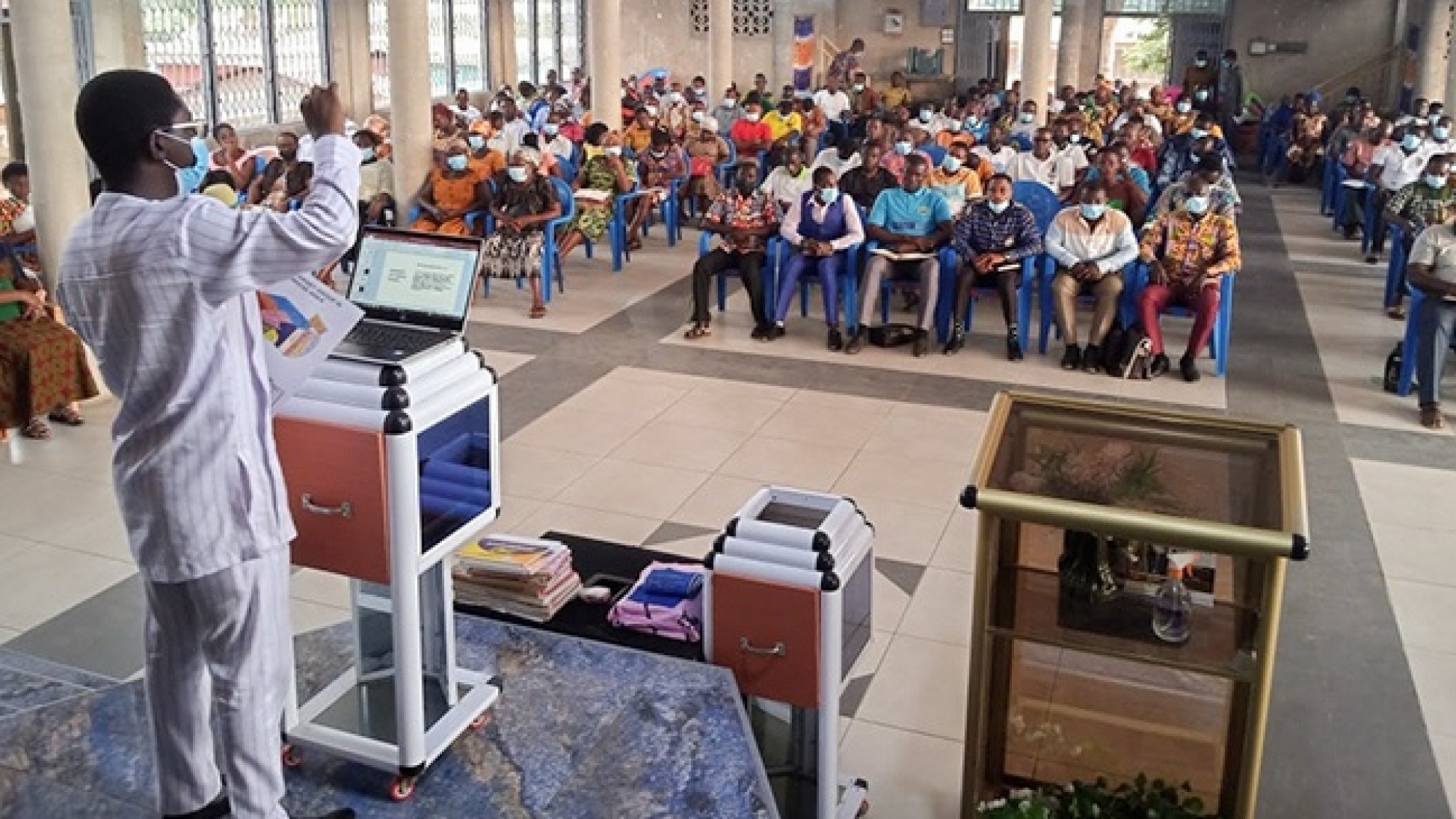
The General Secretary of The Church of Pentecost, Apostle Alexander Nana Yaw Kumi-Larbi, says that the consistency in observing the commands of God (righteousness) is the mark of every true Christian.

Apostle Kumi-Larbi maintains that righteousness is what distinguishes Christians from the people of the world and that it is expected of every believer to lead lives that conform to God’s will.

“Consistently doing good deeds and doing right is the fruit of true sonship in Christ; it is the fruit that shows that Christ lives in us. One can, therefore, not claim to be in Christ without living a life of righteousness,” he charged participants of the ongoing National Officers’ Retreat (Apostolisation) at the Achimota Zone of the Achimota Area yesterday. 

In his presentation on the topic “Righteousness; The Authority of the Kingdom,” the General Secretary defined righteousness as the act of being aligned with how God ordained and sees things in the natural, moral or legal sense. 

“It also means acts, words, deeds, and attitude that are considered right,” he explained.

According to him, the primary reason why Jesus came to earth to die on the Cross was to make it possible for humanity to be restored to God’s righteous standards.

Quoting 2 Corinthians 5:21, he said that Jesus fulfilled all the righteous requirements of the Mosaic law and took the sins and curses of humanity upon Himself on the Cross. For this reason, God made Jesus who knew no sin to bear the sins of humanity so that they (humans) can become the righteousness of God in Christ. 

“Essentially, by this finished work of Christ, we have been imputed with God’s righteousness and have been empowered to live a life of righteousness in attitude, words and deeds,” he said.

Hence, it is unacceptable for any believer to indulge in unrighteous acts because through Christ’s vicarious death, believers have been transferred from the kingdom of darkness (in which they previously belonged) into God’s kingdom of light, he added.

“In the kingdom of God, the scepter, emblem, totem or symbol of authority is righteousness. That is why we the people of the Kingdom must love righteousness and hate evil (wickedness),” he said while referring to Hebrews 1:8-9.

He, therefore, reiterated that the greatest burden or preoccupation of every Christian must be to lead righteous lives.

Apostle Kumi-Larbi also urged Christians to guard their hearts against evil by putting on the breastplate of righteousness (Ephesians 6:14).

“We must put on our moral character (breastplate of righteousness) which serves as the believer’s defense because it protects our hearts from evil,” he said.

He further explained that to protect one’s heart from evil is to be careful of where one sits, stands and walks (Psalm 1:1-3). 

He also advised Christians to be very cautious of the people they choose as friends and acquaintances, stressing that “The people you associate with will determine how far you go in Christ.”

Highlighting the significance of righteousness in nation-building, the General Secretary said that nations whose citizens lead lives that conform to the will of God are prosperous.

He further explained that it is not enough for leaders to enact laws for their respective nations, rather, what the world needs are leaders who pass right laws and apply them.

Apostle Kumi-Larbi, therefore, urged national leaders not to emulate the hypocritical behaviours of the Scribes, who only taught the laws, or the Pharisees, who were selective in the application of laws. Instead, he advised them to subject themselves to the laws of their nations and to put in place systems to ensure that other citizens adhere to them (laws) as well.

PENTECOST NEWS.

CHAIR RAISE

We Need God-Fearing Christians To Possess Nations For Christ – Apostle Nyamekye

Apostle Eric Nyamekye, Chairman of The Church of Pentecost, has urged the clergy and church officers to make a concerted effort to raise God-fearing members to carry out the “Possessing the Nations” agenda.

According to Apostle Nyamekye, God has saved believers so that they can be saviours of the world.

“Consider every member of the church to be a saviour of the world,” the Chairman of The Church of Pentecost stated when speaking during the inaugural joint service of the Bolgatanga and Bawku Areas Officers’ Retreat (Apostolisation), Ministers and Wives session today at Bolgatanga Central Assembly Auditorium in the Upper East Region of Ghana.

Speaking on the theme: “The Church as an Equipping Centre in Carrying Out the Great Commission,” Apostle Nyamekye stated that the Great Commission’s mandate extends beyond evangelism.

According to the Chairman, evangelism is about presenting the gospel in order for people to accept Christ, whereas the Great Commission is about going out and discipling the nations.

“The church is God’s equipping centre and vehicle for possessing the nations. We must instil in the members’ the values and principles of God’s Kingdom,” he said.

He encouraged ministers to do everything for the glory of God because everything done in the church is done in preparation for the Great Commission.

He urged the clergy and the officers to carry out their missions outside of the church, adding, “The church is not the focus of the Great Commission, but the church is the most significant tool for carrying out our Lord Jesus Christ’s Great Commission.”

Apostle Nyamekye also charged church leaders to spend time preparing before going to their churches.

“As pastors, the districts and communities where you have been assigned to serve are placed in your mandate. Use The Church of Pentecost to affect the whole town as you possess your territories for Christ,” he stated.

He continued: “Pay attention to your Presbytery; they are the primary focus for advancing the agenda at the local level. The most important individuals in the church are the human resources,” he remarked.

He advised the clergy to abandon their arrogance and instead carry the knowledge of God’s elevation in their life.

“Be a pastor among pastors and have a pastor mentality wherever you meet as pastors,” he said.

He counselled both the clergy and the officers to strive to cultivate and carry God’s presence.

“When you are a pastor, cultivate the presence of God, because when you backslide, the entire church backslides,” he said.

He directed the ministers to teach the members how to receive from God, saying, “God’s ability to pour into us is dependent on our ability to receive.”

“The people of the world should receive the law of the Lord (Word of God) from the church. When this is done, there will be no war. The church is supposed to be the teacher of God’s ways,” he noted.

He implored the church to uphold the truth because the church is the truth’s teacher.

“Once the church ceases to uphold the truth, it will destroy society,” he stated.

“The minister should devote time to studying the Bible. To grasp the theology behind the scriptures, he must read. “Do your utmost to gain God’s approval,” he said.

About 47 ministers and their wives from the Bolgatanga and Bawku Areas attended the opening session.

PENTECOST NEWS.

Bolgatanga, Bawku Areas Hold Joint Apostolisation

Bolgatanga, Bawku Areas Hold Joint Apostolisation

The Bolgatanga and Bawku Areas of The Church of Pentecost, under the leadership of Apostle Emmanuel Kwesi Acquah and Apostle Eric Gyambibi Boateng respectively, have held a joint session to open the 2022 Ministers and Officers’ Retreat (Apostolisation) at Bolgatanga Central assembly, in the Upper East Regional capital. 

Other sessions would be held separately in the two areas. The Bolgatanga and Bawku Areas are the only areas in the Upper East Region.

This year’s retreat began on Tuesday, February 22, 2022, and will end on Sunday, February 27, 2022, at all zones in the two areas.

Under the main theme of the church, “Equipping the Church as an Army to Possess the Nations,” seasoned ministers of the church will be ministering on various sub-themes.

Notably among the speakers for the Apostolisation are Apostle Eric Nyamekye (Chairman), Apostle ADP James Teye Tetteh (Immediate Past Chaplain-General of Ghana Prisons Service and Resident Minister of Dzorwulu English Assembly), Apostle Daniel Nii Teiko Tetteh Tackie (Wa Area Head), and Apostle Abraham Swanzy (Director of Ghana Evangelism Committee and Resident Minister of Greenwich Meridian).

Apostle Sylvester Arhin, Chairman for the Northern Regional Coordinating Committee and Tamale Area Head, who also doubles as an Executive Council Member of the church, in his welcome address, urged ministers and their wives to treasure the teachings that would be received throughout the retreat.

The Bolgatanga Area comprises Bolga, Navrongo, Zuarungu, Sandema, Bongo, PENSA TS Upper East Sector, Bukere, Chuchuliga, Sambrungu, Bolga Estate, Paga, Nia, Biu, Mirigu, Doba, Fumbisi, Siniensi, PIWC-Bolgatanga, Wiaga, Soe, Sirigu, Chiana, Kanjarga, Tongo, Sheaga, Dorungo, Zorko, Nangodi and Namoo districts.

The Bawku Area also comprises Bazua, Bawku, Garu, Denugu, Binaba, Tanga, Basyonde, Pusiga, Gbantongo, Tempane, Teshie, Zebilla, Atuba, Songo, Sapeliga, Aramkoliga, Kugsabila, and Missiga-Kulungungu districts.

In the Bolga Area, the retreat will be held at Zonal levels in the Siniensi, Bolga, and Navrongo.

The Chairman of The Church of Pentecost, Apostle Eric Nyamekye, would be participating throughout the various sessions within the two areas.

PENTECOST NEWS.

Ashanti Bekwai Area Holds Breakfast Meeting With Government Officials

Ashanti Bekwai Area Holds Breakfast Meeting With Government Officials

As part of the vision by The Church of Pentecost to possess the nations for Christ, the Ashanti Bekwai Area of the church has organised a day’s seminar for government officials in Amansie in the Ashanti Region.

The purpose of the meeting was to interact and share the church’s vision with key stakeholders in the area.

The programme, which was held at Yeguaa Hotel in Ashanti Bekwai on February 17, 2022, brought together Heads of Government Departments and Agencies in Amansie.

Apostle Fred Tiakor, the Ashanti Bekwai Area Head of The Church of Pentecost, who convened the meeting, in an address, said the Church in collaboration with the heads of institutions can build clean and developed communities devoid of criminalities.

Rev. Philip Tutu (International Christian Ministry, Ghana) who was the main speaker for the seminar spoke on the subject: “Advocating for Peace and Progress in Amansie Communities.”

He said that the role of leadership in ensuring peace in Amansie and the world at large is very important. Since everything rises and falls on the leader, he indicated that leaders in Amansie communities have a major role to play in ensuring the peace and progress of their communities.

He noted that where there is no peace progress is impossible. To Advocate for peace and progress, he called on the people in the area to be each other’s keepers.

“We should be people that seek the best of interest of the other person and the community at large, since a kingdom divided among itself can never stand,” he stated.

He added: “Advocating for peace and progress in Amansie communities should be a shared responsibility. This calls for a total commitment of all and not a few, and an attitudinal change. Advocating for peace and progress means giving a person support to have their voices heard, hence Amansie needs a voice.”

Rev. Philip Tutu reiterated that to ensure and sustain peace in Amansie communities and Ghana at large there should be improved collaboration between religious bodies, government, media, security services, families and labour associations.

He stressed the need to build the capacities of security forces to avert crimes and terrorist attacks.

Touching on some of the benefits of peace, he said that a peaceful nation or community attracts investment which reduces unemployment. He added that when there is peace, tourism potentials will be explored and put to use; people will not live in fear of being attacked, while children will grow in the land of their ancestors.

Politically, Amansie consists of Bekwai Municipality, Amansie West, Central, and South Districts with a vast population of 340,383 people based on the 2021 Population and Housing Census report. The people are predominantly farmers, partial small-scale miners, and petty traders.

In attendance were Asante Bekwai Divisional Police Commander, Heads of Senior High Schools in Amansie communities, Representative of Bekwai Municipal Chief Executive, Bekwai Municipal ECG Engineer, Manager of GCB – Bekwai, Manager of Amansie Rural Bank, Bekwai Municipal Head of Forestry Commission, and other representatives of Civil Society Organisations in Amansie.

Report by Overseer Frank Osei Tutu.

Untitled-2 (2)

Couple Married For 8 Years Without Issue Finally Welcomes First Child

One of the expectations couples hope for after a marriage ceremony is to be blessed with the fruit of the womb. But to Mr. Eric Baah and Mrs. Victoria Owusu Baah, the situation was unpleasant and disturbing as the couple after eight years of marriage did everything humanly and medically possible to conceive but to no avail.

Mr. Eric Baah is a member of the Presbyterian Church while his wife, Victoria is a member of The Church of Pentecost in Old Tafo Akim District of Effiduase Area. According to him, they got married on 20th December 2014 full of expectations to be blessed with the seed of the womb. However, they kept on anticipating as the years went by but without any sign of conception.

They recounted the humiliations and the stigmatization they had to endure from friends and family members and even some church members, making the situation unbearable. Not only that, they spent a huge sum of their earnings on medications, jumping from one hospital to another, including fertility hospitals, with the aim of having a child but to no avail.

At a point, he even advised his wife not to move forward whenever childless couples were called out for prayers. He said that though it was not easy, they encouraged themselves and trusted and believed God for a miracle.

To their surprise, Comfort conceived in February 2021 and gave birth to their beautiful Erica Nyameakwan Fosuhemaa Baah Miracle in November 2021.

According to Mrs. Victoria Owusu Baah, she received her miracle during the January 2021 session of the District Monthly Prayer Warfare dubbed “Miracle Hour” organised by the Old Tafo Akim District of The Church of Pentecost.

Recounting her story, she said the District Minister, Pastor Prince Odoom, during the prayer hours, called for childless couples and she quickly moved forward. After the prayers, she said that she had a dream that same night harvesting fishes from a well she went to fetch water for masons working on their church building. In the dream, the presiding elder asked her to take the fishes home and the following month her menstrual cycle ceased. She even thought of it as a sign of early menopausal age since she was 39 years old. But a test conducted later proved that she was pregnant.

The baby girl was christened and dedicated by Pastor Prince Odoom on Sunday, February 6, 2022, at the Maranatha Assembly where Mrs. Victoria Owusu Baah worships.

To God be the Glory.

Report by Enoch Obeng Asare, Old Tafo Akim District Media Coordinator.

The Army Of God Must Never Relax – Apostle Mike Etrue

The Army Of God Must Never Relax – Apostle Mike Etrue

The Kaneshie Area Head of The Church of Pentecost, Apostle Mike Kwame Etrue, has charged Christian armies not to relax in their quest in possessing the nations for the Lord, stressing that, true soldiers of Christ are always vigilant.

In his opening address at the 2022 Kaneshie Area Officers’ Retreat (Apostolisation) on Monday, February 21, 2022, at the Kaneshie Central Auditorium, he said that as army of God, Christians need to be equipped with the full armour of God so that they can withstand the tricks and schemes of the enemy.

According to him, the armour of God is furnished by God himself and that he [God] enjoins every believer to put it on, saying, “It must be worn day and night; we must walk, work and sleep in them.”

Apostle Etrue, an Executive Council Member of the church, explained that the annual Apostolisation is a capacity-building and training programme instituted by leadership of church to equip and empower church leaders to be able to discharge their duties effectively.

This year’s nation-wide Apostolisation programme is under the theme, “Equipping the Church as an Army of God to Possess the Nations” (Hebrews 13:20-21; Ephesians 4:11-12; 6:10-12) which is the 2022 theme of the church.

“This theme calls for vigorous and intentional equipping of the church to get every single member of the church to assume the posture of an army of the Lord to take the nations,” he said.

He added: “In doing this, we intend to use the metaphor of the armour of God to get our members to understand from the lenses of scripture, the social, political and spiritual forces at work in the various spheres of society and to build their defences against their onslaught.”

Apostle Mike Etrue was hopeful that through the retreat the Lord would raise an equipped united army and release them to equip his church to possess the nation.

Guest speakers at the programme are Apostle Emmanuel Agyemang Bekoe (International Missions Director) and Apostle Wilberforce Nkrumah Agyeman (Teshie-Nungua Area Head).

PENTECOST NEWS.  

RETHINKING AGRIBUSINESS - THE CHURCH OF PENTECOST MEN’S MINISTRY PERSPECTIVE

Rethinking Agribusiness: The Church Of Pentecost Men’s Ministry Perspective

Over the years, agricultural activities in Ghana and many parts of Africa were largely limited to subsistence farming. In recent times, however, the focus has shifted to agribusiness. The development of agribusiness has not only added impetus to the food value chain, but has also become a viable strategy in addressing the socio-economic challenges of society.

What is Agribusiness?  

It is not far-fetched to decipher the meaning of the term agribusiness from the layman’s perspective. As can be inferred from the name of the term, it is a combination of two words: “agriculture” and “business” and that gives an idea of a business-oriented farming activity. Agribusiness involves the market-worthiness of farm produce, its processing, and strategic distribution to consumers.

Agribusiness encompasses the use of any arable land for farming-related commercial activities such as animal breeding, crops husbandry, api-culture (bee-keeping), mushroom farming, and all aspects involving the agriculture value chain. Depending on the resources available and the context in which the project is carried out, the methodologies of doing agribusiness can be varied but sophisticated. That said, there are also simple ways by which farmers can start their agribusiness without depending on huge investments or delving into such complexities.

The agribusiness industry is relevant to every local context in such a way that one can start as a small-scale, medium-scale or large-scale activity, depending on availability of resources and other related factors.  The technology to use, the method of processing and distribution of the produce may depend on the category of agribusiness chosen by the farmer and the type of farming system involved in his activities.

The Economic Significance of Agribusiness

There is no doubt that humankind needs food to survive and that alone is a fundamental reason to go into agribusiness. Barring fasting and prayers, the religious person must feed on the produce of farmers to recoup energy to embark on his duties. All living organisms depend on food to survive, many of which contain agriculture produce from farmers.

Although some agribusiness industries also process agricultural products such as timber, which may not be part of edible farm produce, they are still important components of the agribusiness sector. Profit maximisation, conservation, and sustainability of the food value chain, with their benefit to the socio-economic development of society, are fundamental to the agribusiness venture.

Poverty reduction is very crucial in the economic significance of agribusiness as long as many in the developing world still live on farming. The agribusiness industry has the potential to create jobs in the private sector because of its inherent complexity and comprehensive farming activities. From production, processing, to distribution of farm produce to the market, the farmer needs more labour to accomplish his aim.

Since increasing unemployment is a societal issue, the church being no exception, agribusiness is a strategic venture that faith-based organisations like the church can explore to stabilise the economic challenges of its members. The church (the wider Christian community) by its calling has a dual purpose – service to God and service to humankind. This does not necessarily mean that the church should make the establishment of agribusinesses its major practice. That notwithstanding, the church, by its diverse resources, is strategically positioned to provide the needed technical support on agribusiness so that interested members or the larger society can leverage on the opportunities created for their agribusinesses.

Why is Agribusiness Necessary for the Pentecost Men’s Ministry (PEMEM)?

The agribusiness system forms part of the social intervention activities of the Ministry as its commitment to the general vision of the Church. The Church of Pentecost, through its five-year vision known as Vision 2023, has committed itself to various kinds of social intervention and community development programmes meant to address the socio-economic challenges faced by society. The Vision states, in part, that “The Church is instrumental in fostering growth and transformational development of every nation. Over the years, The Church of Pentecost has been instrumental in promoting growth and sustainable development in Ghana” (2018:29).

PEMEM, as a special ministry of the church, is committed to promoting the social transformation agenda of the Church’s vision coupled with the need to address the socio-economic challenges of the church’s members, particularly men in the church. Arguably, it would be unpleasant for a “hungry woman to submit (as indicated in Eph. 5:22) to an ‘irresponsible’ husband” – a general homily during marriage seminars.

When there is severe hunger in the household, the whole family becomes devasted, and frustrated and that is why empowering men in agribusiness skills as critical agents for tackling hunger and poverty is vital. The empowerment of men in the agribusiness sector is a prerequisite for the economic transformation agenda of society.

To compliment The Church of Pentecost’s agenda on possessing the nations, as indicated in the Vision 2023, the Men’s Ministry identifies agribusiness as a strategic place. The Ministry takes into account the numerous members of the Church who depend on subsistence farming as their major source of livelihood most of whom are men. Thus, any hindrance to the economic viability of men would have far-reaching consequences on the development of the family. It is with this in mind that PEMEM takes keen interest in promoting agribusiness among its members as a game-changer in the agricultural industry and the general management of the economy our various families and communities.  

Models of PEMEM Agribusiness

There are two models of PEMEM agribusiness outlined in the strategic plan of the ministry.

Model Farm Concept

For people to experience the possibility of having agribusiness in our Ghanaian context, the Men’s Ministry encourages the establishment of model farms with a high sense of technical support and grassroots participation. The PEMEM model of agribusiness will provide the average farmer with modern skills to increase food productivity while taking into account sustainable marketing of farm produce. The Ministry has identified activities like livestock production, aquaculture, api-culture, and crops farming as pivotal to economic growth of society.

Integrated Agribusiness Village

The Ministry has no intention to embark on large-scale commercial agribusiness activities, but a small-scale system, or model farms or demonstration farms for others to emulate the standard way of agribusiness systems available. The proposed integrated agribusiness includes a number of agricultural productivities taking place in a piece of land at the same time. In a technical sense, the integrated agribusiness model consists of very complex factors like soil management and fertility, crop and animal husbandry, and marketing of agricultural productivity, among others.

However, the PEMEM model of integrated agribusiness takes a slightly different approach. For example, in a land of about three acres, the Ministry suggests livestock, crops, aquaculture, and all forms of agriculture activities sited on the land. The targeted groups by the Ministry are individuals, districts, areas, and ministries of the Church which are financially and technically capable and may be willing to establish and manage these systems of agribusiness whose success stories others can experience and adopt. The idea is to use it as an educative model and transformative agenda in the agribusiness sector for those who may be interested in agribusiness but skeptical about its success and sustainability.

Empowering Women

It is worth noting that the Men’s Ministry sees agribusiness as a strategic activity to economically empower women, be it small, medium or large scale. The four-year strategic plan of the Men’s Ministry focuses on the holistic development and prudent economic management of the home and society at large. To achieve this goal, the Ministry considers women’s engagement in the agribusiness sector not only as a crucial for the home, but also as a game-changer in our quest for socio-economic improvement of society.

Women can venture into all kinds of agribusiness models. For example, the small-scale agribusiness model could even be established at homes that have spaces to accommodate farms such as grasscutter, rabbits, poultry, piggery, goats, vegetables, and fish farm. These are small scale, but can contribute to the food value chain and can be of immense support to the family.

Man as the Head of the Family

As heads of the family, it is men’s responsibility to improve the livelihood of their homes. Engaging them with all the technical support and the necessary skills to embark on agribusiness is very important for social development of families, communities, and humanity in general. This is against the backdrop of one of the Ministry’s Akan songs with its English translation below:  

I am a man, it’s my responsibility to build a prosperous home, because

When the home prospers, the church will prosper

When the church prospers, the nation will prosper, and

When the nation prospers, everything will successful.

This song underlies the philosophy of the Men’s Ministry, which is to build a solid home being fully aware that, the home is the basic unit of society. Once the home is well organised, peaceful, and prosperous, it will have a positive impact on the socio-economic development of society.

To accomplish the mandate stated in the song, it requires the holistic development of men and that is why the Ministry has rolled out four thematic areas in its strategic plan: spiritual, physical, sociological, and psychological development of men.

The Ministry’s agribusiness, therefore, falls within the context of sociological development of men. It is part of its social intervention activities, which gives an idea that any transformative impact felt by society must first be experienced at home. 

Curbing Rural-Urban Migration

Today, it has become a general phenomenon where people consistently migrate from the rural communities to urban centres for ‘non-existent’ greener pastures, but there is the need to take a positive action that can reverse this trend. Thus, the promotion of agribusiness at all levels of society is not only to address the world’s basic need of food, but to also foster stability of the movement of people in terms of rural-urban migration. Owing to lack of jobs in rural areas, it is becoming a general practice for young people to migrate to urban centres for non-existent greener pastures.

The phenomenon of massive rural-urban migration poses real challenges to mission activities of the church. Should it continue, it is not only some rural churches or parishes that may face a sharp decline in their membership in the near future, resources pumped into missionary work and infrastructural development may struggle to be sustained.

The large following of the churches in the rural communities should therefore help them see the proposed model of agribusiness initiated by PEMEM as a way out of poverty and perennial rural-urban drifts and an opportunity to embrace economic development.

Conclusion

Poverty is a threat to the growth of the church to which agribusiness is an antidote and must be embraced by all. It is believed that promoting agribusiness among the faith-based organisations is a basis of economic transformation of society. When agribusiness gains momentum among men, particularly the models being promoted by PEMEM, there will be a colossal positive impact on families and society as a whole.

The full participation of men in agribusiness is required in improving the food value chain and economically empower them to take responsible positions in society. Agribusiness is a crucial aspect of productive farming system that must be embraced by all. May the golden chance to seriously address their situation not elude them.

Vincent Anane Denteh (Apostle)

Email: vadentcop@gmail.com

© 2022

Children Ministry Director

Jethro Initiative To Boost Teacher-Children Engagements – Children’s Director

The Children’s Ministry Director of The Church of Pentecost, Pastor Prof. William Otoo Ellis, says the introduction of the Jethro Initiative (JI) by his outfit will serve as an alternative way of increasing engagement between Children Ministry’s teachers and the children.

“The membership of the Children’s Ministry is currently more than a million. However, our engagement with our children is mostly on Sunday mornings, and in this dispensation where services have been further reduced to two hours due to COVID-19. This means, we spend less time with the children. It has, therefore, become important to have the JI meetings as an alternative way of engaging children,” he said in a documentary that was shown at the launch ceremony yesterday.

He explained that the Jethro Initiative, which has “Nurturing unto Godliness” as its slogan, is not meant to replace the Sunday Morning meetings.

“JI aims to complement and strengthen the activities of the Children’s Ministry in building the foundation of the children in Christ and His word whiles making their walk in the Faith exciting through intentionally designed extra-curricular activities,” he stated.

He further noted that unlike Sunday morning classes, JI meetings are not restricted to only members of the Children’s Ministry but must be opened to all in line with the Church’s “Possessing the Nations” agenda.

The initiative was officially launched yesterday by the Chairman of the Church, Apostle Eric Nyamekye, following a successful pilot of the project in selected areas of the Church in Ghana.

Among other objectives, the initiative seeks to raise godly transformational future leaders, promote team work and unity among children, make the study of the word of God fun and innovative, inculcate a high sense of civic responsibility and patriotism in children, promote holistic growth and development of children, introduce children to role models, coaching and mentoring, create an opportunity for effective evangelism among the children in their community, encourage children to learn social skills, resilience, resourcefulness and empathy, as well as nurturing and maintaining the love for church attendance and participation in children.

The JI requires that children of ages 7 to 12 years in a particular assembly (local church) are broken into smaller groups. These groups, named after the Fruit of the Spirit (Galatians 5:22-23), should each comprise of 10 to 20 children. Members of each group would appoint two of its members to serve as a Group captain and assistant. The assembly would then appoint an overall JI Prefect and Assistant to coordinate the activities of the various JI groups. That notwithstanding, each group, must be supervised by at least one Child Worker (teacher).

The preferred day for JI meetings is Sunday afternoon. Saturday afternoon may be considered as a second option based on geographical or peculiar reasons. Although JI meetings are to be held for a maximum duration of one hour and 30 minutes, the acceptable time range is 2pm and 5pm.

Some of the special activities of JI include Character Studies in the Bible, Christian Family Values, My Environment, My Responsibility, Leadership Day, Talent Exhibition, Talk Shows, Civic Education, Reading Club, Family Day Out, Games, Learning to Serve, Music and Drama, Quizzes, Debate, Sword Drill, My Community My Treasure, and Bible Recitation.

In line with the operational guidelines of the Jethro Initiative, no JI meeting is to be held on Lord’s Supper Day.

PENTECOST NEWS

JI IS here

Jethro Initiative Is Here To Stay – Chairman

The Chairman of The Church of Pentecost, Apostle Eric Nyamekye, has called on church leaders and parents to wholly embrace and ensure the successful implementation of the Jethro Initiative (JI) of the Children’s Ministry (CM), stressing that the novelty is here to stay.

Speaking at the official launch of the initiative yesterday, Apostle Nyamekye said that the JI is one of the major interventions of the Children’s Ministry approved by the Executive Council of the Church.

He said that the new world order, which is characterised by the increasing rise of secular humanism, lack of parental attention for children as well as the lack of capacity of most parents with respect to technology in nurturing of the present-day child, among others, has necessitated the introduction of the Jethro Initiative.

He stated: “Over the last 50 years, a lot has been done by the church to nurture godly children. However, the changing times creates more challenges and, thus, the need for a review and shift in approach. This new dispensation calls for a new type of Christian children and a new approach to the raising of our children.”

“JI is intended to raise godly transformational future leaders; make the study of the word of God fun and innovative as well as nurture and maintain the love of children for church attendance and participation,” he further stated.

The Jethro Initiative, which has as its slogan “Nurturing unto Godliness,” is an extra-curricular programme of the Children’s Ministry aimed at complementing and strengthening the activities of the Sunday Schools in building the foundation of children in Christ and His word and entrenching them on the need to walk in the Faith.

According to the Chairman, JI would also help create an opportunity for effective evangelism among children in their communities, inculcate a high sense of civic responsibility and patriotism in them; promote their holistic growth and development, encourage them to learn social skills, resilience, resourcefulness and empathy, and promote teamwork and unity.

He was also hopeful that, through this initiative, the “Possessing the Nations” agenda would remain relevant and sustainable from generation to generation, particularly to the next generation of Christians.

To achieve the intended JI objective, the Chairman urged CM workers to have a closer relationship with God in this renewed effort to raise and nurture godly children. He also advised them to update their knowledge in current trends and happenings in order to meet the social, spiritual, emotional and intellectual needs of the children.

Apostle Nyamekye, thus, reiterated that children are the most vulnerable members of society and therefore require special attention to guide, guard and nurture them into responsible, mature and effective Christian adults who can transform their spheres of influence with Kingdom values and principles.

“All stakeholders in child development like parents, the church and the community must, therefore, get involved as we seek to promote the holistic growth and development of our children,” he charged.

PENTECOST NEWS.

launch 2

Jethro Initiative Officially Launched

The Jethro Initiative (JI), a newly-introduced programme of the Children’s Ministry of The Church of Pentecost, was officially launched yesterday at a special ceremony held at the Burma Camp Worship Centre in Accra.

The JI has now been fully adopted by the Church after a successful pilot of the programme in selected areas of the Church in Ghana.

Launching the novelty, the Chairman of the Church, Apostle Eric Nyamekye, said that the strategic importance of children in ensuring that the “Possessing the Nations” agenda remains relevant and sustainable from generation to generation cannot be overemphasised.

He said that the JI has been initiated to complement and strengthen the activities of the Children’s Ministry in building the foundation of the children in Christ and His word whiles making their walk in the Faith exciting through intentionally designed extra-curricular activities.

The Patron of the Ministry, Prophet David Kankam-Beditor, in an address at the event, said that the pilot programme of JI in some selected areas in Ghana yielded positive results, a reason why it has now been approved by the leadership of the Church to be fully rolled out.

The Ashaiman Area Head, who doubles as an Executive Council Member of the Church, therefore, appealed to church leaders and parents to embrace it wholeheartedly. 

“Through this initiative, God is going to equip our children to grow in Him and impact their generations,” he said.

The Children’s Ministry Director, Pastor Prof William Otoo Ellis, in a documentary shown at the launch, said that the initiative was introduced by the ministry as an alternative way of increasing engagement between CM teachers and children.

“The membership of the Children’s Ministry is currently more than a million. However, our engagement with our children is mostly on Sunday mornings, and in this dispensation where services have been further reduced to two hours due to COVID-19, this means we spend less time with the children. It has, therefore, become important to have the JI meetings as an alternative way of engaging the children,” he said.

He revealed that the programme seeks to break children into smaller groups based on the principle of leadership proposed by Jethro to his son-in-law, Moses (Exodus 18). He further revealed that these groups are named after the Fruit of the Spirit (Galatians 5:22-23).

On her part, Mrs Freda Koranteng, a National Executive Committee of the ministry and the JI Coordinator, said that, as part of the initiative, special activities have been designed to meet the transformational needs of the children. These include Character Studies in the Bible, Christian Family Values, My Environment, My Responsibility, Leadership Day, Talent Exhibition, Talk Shows, Civic Education, Reading Club, Family Day Out, Games, Learning to Serve, Music and Drama, Quizzes, Debate, Sword Drill, My Community my treasure, Bible Recitation, among others.

The age range of children who can attend JI meetings is 7 to 12 years. According to her, this is because children of this age group are fairly independent and mature and can easily attend JI meetings on their own.

“That notwithstanding, some parents still bring their wards for JI meetings,” she added.

Mrs. Koranteng also noted that: “The preferred day for JI meeting is Sunday afternoon; Saturday afternoons may also be considered based on geographical reasons. The meetings should be held between 2 pm and 5 pm. However, the duration for every JI meeting should not exceed an hour and 30 minutes. This means that by 5:00 pm, we expect every JI meeting to be closed.”

She, however, reiterated that JI should not replace the Sunday morning meetings; rather, JI seeks to complement and make CM meetings more active and participatory.

Present at the event were Apostle (Lt. Col.) B. G. Kumi-Woode (Resident Minister, Burma Camp Worship Centre), Pastor Prof. William Otoo Ellis (Children’s Ministry Director), Elder Lawyer Alfred Aidoo (Deputy Children’s Ministry Director), some members of the National Executive Committee (NEC) of the ministry, Children’s Pastors, as well as Children Ministry workers and children from some selected areas in the Greater-Accra region.

PENTECOST NEWS