Women’s Director Ends Ashanti Regional Tour web

Women’s Director Tours Ashanti Region

The Director of the Women’s Ministry of The Church of Pentecost, Deaconess Philomena Mireku, together with her entourage, is on a working visit to the Ashanti Region of Ghana.

The duty tour began on Tuesday, July 4, 2023, in the Bompata Area, where a leadership seminar was organised for ministers’ wives, Women’s Ministry executives at all levels, deaconesses, and Virtuous Ladies’ coordinators.

Mrs. Mireku also visited the Old Tafo Area on Tuesday evening to interact with the women there.

The Old Tafo Area Women’s Ministry Executive Committee, led by Deaconess Mavis Addai, honoured the Women’s Director and her team for their great work in helping to build the Church of God.

The Director and her team are scheduled to visit the New Tafo Area tomorrow, Thursday, July 6, 2023, to interact with the women.

Report by Elder Nana Nsiah

Children's Workers Are Indispensable – Children’s Ministry Director web

Children’s Workers Are Indispensable – Children’s Ministry Director

The Director of the Children’s Ministry of The Church of Pentecost, Pastor Prof. William Otoo Ellis, has stressed the indispensable role of Children’s workers in the Church’s quest to raise godly children.

Pastor Prof. Ellis said this today in a welcome address to participants at the Foundation Builders’ Conference (FBC’23) currently underway at the Pentecost Convention Centre (PCC), Gomoa Fetteh.

In his speech, the Children’s Director said that children’s workers, who are popularly known as Sunday School Teachers, serve as conduits for raising godly children; hence, there is a need to build their capacities and reignite their passion in the face of the challenges they encounter while discharging their mandate.

He said the Foundation Builders Conference, thus, aims to equip and empower these dedicated individuals for maximum impact in shaping the church’s future.

“The Foundation Builders’ Conference serves as a platform for intentional and continuous training to enhance the capabilities of children’s workers,” he said.

According to him, there is an urgent need to prioritise the development and support of those entrusted with the spiritual well-being of these young members has become paramount especially with the Children’s Ministry accounting for 31.1% of the church’s total population.

Acknowledging the current global trends and the influence of sophisticated systems, Pastor Ellis further highlighted the importance of increasing attention to the Children’s Ministry.

He referred to the Chairman’s recent State-of-the-Church Address at the 46th General Council Meetings, noting the essential role of children’s workers in nurturing godly children who will shape the future of the church and Christendom.

Quoting Matthew 26:31, he reminded the audience of the importance of strong leadership, stating that “strike the shepherd, and the flock will be scattered.”

He, therefore, expressed deep appreciation to the Chairman of the Church, Apostle Eric Nyamekye, the Executive Council Members, and Area Heads for their unwavering support and active involvement in all Children’s Ministry activities across their respective jurisdictions.

He also commended the children’s workers for their dedication and for consistently organising innovative programmes and activities that align with the Ministry’s vision.

This year’s Foundation Builders Conference, which is under the theme, “Rekindling the Zeal of the Children’s Worker for Maximum Impact,” has about 1000 participants in attendance.

PENTECOST NEWS.

Be Evangelistic – Chairman Tells Children’s Ministry Workers

“Be Evangelistic” – Chairman Tells Children’s Ministry Workers

The Chairman of The Church of Pentecost, Apostle Eric Nyamekye, has called on Children’s Ministry leaders and workers at the various levels of the Church to prioritise evangelism in order to lead more children to Christ.

He made this statement during his keynote address at the ongoing Foundation Builders’ Conference (FBC’23) at the Pentecost Convention Centre (PCC), Gomoa Fetteh, this morning.

In his address, Apostle Nyamekye advised the children’s workers not to focus solely on the children within the church but also to minister to other children in their respective communities.

He emphasised the importance of making themselves available to the entire community, as the potential for spreading the Gospel among children extends far beyond the church walls.

“Do not be satisfied with only the children under your immediate care; remember that the whole community is ripe for the taking. Endeavour to possess your community for Christ,” he urged.

The Chairman further encouraged children’s workers to employ various evangelistic methods to effectively engage with individuals in their communities.

He also shared his personal testimony, acknowledging the profound impact the Children’s Ministry had on his own spiritual foundation.

“The Children’s Ministry accounts for 31% of the entire membership of The Church of Pentecost worldwide. Let us strive to double the Children’s membership by the end of the year,” Apostle Nyamekye declared.

Preaching on the topic, “The Determination to Serve and the Delight Of Service”, at the event, the Chairman emphasised the foundational aspect of any development and how it often goes unrecognised.

Drawing parallels, he acknowledged that children’s workers might not receive public recognition for their instrumental role in establishing a solid Christian foundation for the children but should continue to serve the Lord with zeal.

Quoting John 21:15, Apostle Nyamekye outlined how cultivating a deeper love for God enables children’s workers to find delight in their service. This love and passion, he explained, would reignite their zeal in nurturing children’s faith and empower them to overcome the challenges they face.

Apostle Nyamekye concluded his message by commending the children’s workers for their valuable service and reminding them that their work is ultimately in service to the Lord.

PENTECOST NEWS.

Kafaba District Extends Chaplaincy Services To Young Brazil FC

Kafaba District Extends Chaplaincy Services To Young Brazil FC

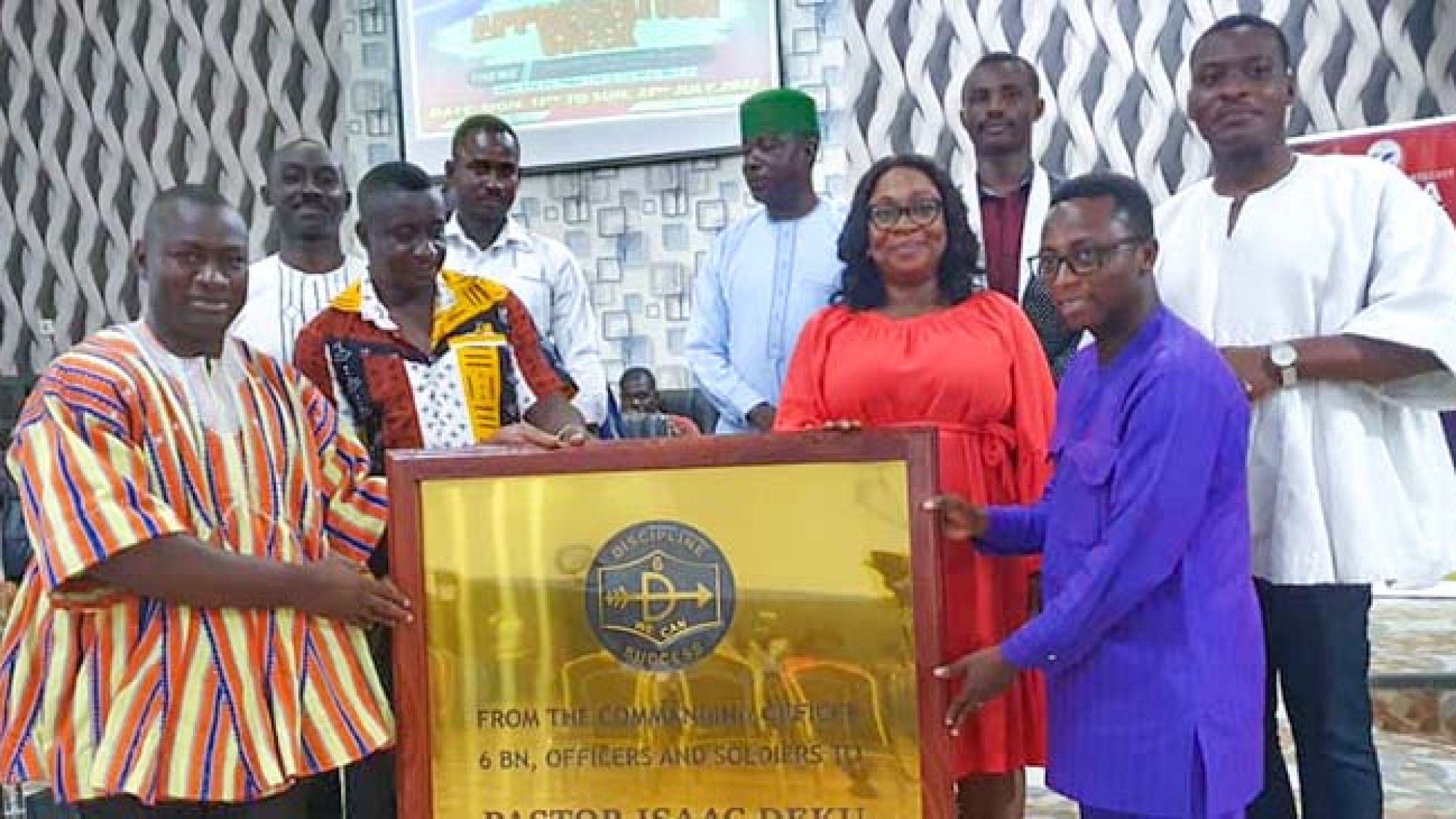
The Kafaba District of The Church of Pentecost has extended its chaplaincy services to the Young Brazil Football Club, a young upcoming team based in Kafaba, within the East Gonja District Assembly in the Savannah Region of Ghana.

To solidify this new partnership, the church donated footballs and sports kits to the team.

During the presentation of these items to the team’s management, Pastor Ebenezer Christopher Tetteh, the District Minister, urged the team members to lead godly lives and avoid any form of deviant behaviour.

He also encouraged them to foster unity and, if possible, maintain peace with everyone.

By the grace of God, two members of the church, Mr. Jackson Koffie and Mr. Moses Amenohu, have been appointed to the team’s management. Their role is to provide chaplaincy services and counseling to the team members.

Expressing gratitude, the team’s captain thanked Pastor Tetteh and the Church for their support and concern for their well-being.

He also commended The Church of Pentecost for their exceptional contributions to the community.

Report by Pastor Solomon Anderson.

Understanding True Holiness That Which Defiles web

Understanding True Holiness: That Which Defiles

INTRODUCTION

In today’s generation, certain acts and behaviours are often considered normal, even among young believers, without proper scrutiny against the Word of God or the leading of the Holy Spirit. Consequently, many individuals find themselves defiled, often unaware of their spiritual condition.

Let us draw inspiration from the story of Daniel, Shadrach, Meshach, and Abednego, who faced a similar challenge during their time in Babylon. In Daniel 1:3-4, we learn that these young men were brought into the service of the Babylonian king and were enticed by the lavish provisions set before them. Temptation surrounded them, and the allure of indulgence threatened to lead them astray. Amidst these temptations, Daniel made a firm resolve not to defile himself with the king’s food and wine. In verse 8 of Daniel chapter 1, the Bible says, “But Daniel resolved in his heart not to defile himself with the royal food and wine.” Daniel demonstrated unwavering determination as he resolutely set his heart and purpose not to violate the divine decrees of his God. Even in the midst of captivity, he tenaciously held onto his convictions, steadfastly refusing to compromise and defile himself in any manner. His commitment to remain faithful to God and His decrees, even in captivity, serves as a powerful example of unwavering dedication to holiness.

To defile oneself means to make oneself spiritually unclean or impure. As believers, we have been redeemed and cleansed by the precious blood of Jesus Christ. Thus, defiling ourselves would entail returning to our former ways.

In Matthew 15:11, Jesus brings a profound revelation regarding defilement. When questioned by the Pharisees about ceremonial cleanliness, Jesus responds, emphasising that what enters the mouth does not defile a person. Instead, it is what proceeds out of one’s mouth that reveals the true state of their heart. Unlike the Old Testament era, where specific foods and drinks were deemed unclean, the finished work of Christ has made all food clean. Our holiness is not determined by external factors but by the transformation that occurs within us through faith in Jesus Christ.

WHAT THEN DEFILES A MAN?

Jesus, in His teachings in Matthew 15:18–20, reveals the true origins of defilement. Let’s read:

“But the things that come out of a person’s mouth come from the heart, and these defile them. For out of the heart come evil thoughts – murder, adultery, sexual immorality, theft, false testimony, slander. These are what defile a person, but eating with unwashed hands does not defile them.”

Expounding on the matter, Jesus explains that the words that proceed from a person’s mouth are reflections of the condition of their heart, and it is these words that defile them. From the depths of the heart, various sinful thoughts and intentions arise, such as murder, adultery, sexual immorality, theft, etc. These deeply rooted impurities are what truly defiles an individual, as they originate from within. Jesus clarifies that external actions, like eating with unwashed hands, do not possess the power to defile a person. Rather, it is the corrupt contents of the heart that ultimately determine one’s spiritual state.

This insightful teaching from Jesus highlights the significance of guarding our hearts diligently. It reminds us that the purity of our innermost being impacts our words, actions, and overall character. By addressing the root of defilement—the heart—we can strive towards genuine holiness and cultivate a life that is pleasing to God.

WHAT THEN SHOULD WE DO?

In light of the understanding that defilement stems from the heart, we are compelled to take action. Proverbs 4:23 provides us with invaluable guidance on how to proceed:

“Above all else, guard your heart with all diligence.”

As dearly beloved children of God, let us embrace this divine instruction and wholeheartedly commit ourselves to safeguarding our hearts. With utmost care and vigilance, we should protect our innermost being, ensuring that it remains free from contamination and impurity. By doing so, we honour God and preserve the sanctity of our relationship with Him.

In this pursuit, we must anchor ourselves firmly in the Lord, trusting in His faithfulness and relying on His strength. As we remain rooted in Christ Jesus, our Savior and Lord, we receive the power and grace needed to overcome the temptations and influences that seek to defile us.

May these words serve as a gentle reminder and encouragement to prioritise the guarding of our hearts diligently. Let us continually seek the guidance of the Holy Spirit, allowing Him to purify our innermost being and align our thoughts, words, and actions with God’s righteous standards.

Written by Deacon Derrick Ameyaw Asamoah (Peniel English Assembly, Sagnarigu District – Tamale Area)

Enhance Your Facilitation Skills – Pastor Adjei Advises Children’s Workers web

Enhance Your Facilitation Skills – Pastor Adjei Advises Children’s Workers

Children’s workers of The Church of Pentecost have been urged to improve their presentation and facilitation skills in order to excel in their role as child facilitators.

Pastor Peter Adjei, the Greater Accra Children’s Pastor of The Church of Pentecost, issued this call on Tuesday, July 4, 2023, during the 2023 Foundation Builders’ Conference (FBC’23) at the Pentecost Convention Centre (PCC) in Gomoa Fetteh.

Speaking on the topic “Facilitation Skills,” Pastor Adjei expressed concern about how some children’s workers continue to struggle with handling various topics in their ministries.

“All around the world, people struggle to connect. Great ideas are discarded or left unsaid, and strategies are not understood. A lot of the time, people can’t connect because workshops or meetings are improperly structured, with too many things happening at once,” he noted.

Pastor Adjei emphasised that two crucial elements that drive every meeting are the content and the process. He further stressed the importance of structuring meetings into different stages and using group tools to ensure a clear understanding of the content and keep everyone on the same page.

To achieve success as a facilitator, he asserted the need for one to be skilful with the Heart, Head, and Hand (3Hs).

He explained that the Heart encompasses the attitude and character the facilitator must demonstrate, while the Head and Hand represent the knowledge and skills required in the facilitation process, respectively.

Concluding his presentation, Pastor Adjei noted that although knowledge and skills are important, the Heart (attitude and character) of the facilitator remains paramount, saying: “The Heart of every facilitator is the most important in every facilitation process because if the Heart is corrupt, both the Head and the Hand will be corrupt too.”

PENTECOST NEWS.

How Much Is Enough Lessons From My Trip To The Convention Centre

How Much Is Enough? Lessons From My Trip To The Convention Centre

The euphoria surrounding preparation, planning, and packing for excursions, retreats, travel, and convention trips is better experienced than narrated. It becomes even more intense when you are fortunate enough to be invited as a key participant in the program at hand. On one occasion, I was invited to participate in a 4-day program at the Pentecost Convention Centre (PCC), located in Gomoa Fetteh, in the Central Region of Ghana. The thoughts of the serene environment, the ambience, and the spiritual connectivity of the Centre alone would make anyone contemplate what to pack in their luggage. My wife assisted me in packing the items I needed. Interestingly, the packing process started in one room and had to be completed in another. With her help, I selected shirts of various types, a pair of trousers, suits, new and undershirts, pants, and shoes of different kinds and colours, and to appear official as a Minister of the gospel, a couple of ties and clerical attire. Consequently, I had a whole bag filled with electronic gadgets, another for personal belongings, and the suits and shirts neatly ironed and hung in the back seat of my vehicle.

On the day the power-packed programme concluded, and I entered my lodging room to begin packing my belongings, I realised that out of the five black shoes I had packed, only one had been worn throughout all the sessions. Surprisingly, neither of the two body sprays I brought for the trip was used. To my embarrassment, I only needed three out of the many colourful shirts, both new and old, for the entire program. The suits were untouched as well, so you can imagine the number of undergarments I packed that went unused. Do I need a lecture on planning and packing for trips? I don’t think so because, at the time of packing, there were justifiable reasons for every item I chose and the amount of luggage I carried. Why did I only use 10% of the things I brought but still had a great time and looked presentable throughout the sessions? The Holy Spirit provided me with an excellent but profound answer when He said, “Just enough should have been okay as pilgrims in this life.” Wow! Jesus’ advice to the disciples came to mind. He instructed them, saying, “Don’t carry a traveller’s bag with a change of clothes and sandals or even a walking stick. Don’t hesitate to accept hospitality, because those who work deserve to be fed” (Matthew 10:10). Although the definition of “enough” may vary and be challenging to determine, the Holy Spirit teaches us to recognise what constitutes enough in everything that comes our way. I also realised on the day we were all packing our luggage from our rooms and vehicles were departing in groups, how empty and lonely the few who remained at the Centre would feel when all the participants were gone. Through my numerous visits to the Pentecost Convention Centre (PCC), where I invite you to embark on a journey of spiritual renewal with your family and friends, I have learned the following lessons worth sharing:

  1. In this life, we don’t need everything our hearts and minds, or others make us believe we do.
  2. Therefore, let us not fight and acquire things through ill-gotten means, knowing they will only become extra baggage that weighs heavily on us when our time in this life is over.
  3. Unfortunately, we often accumulate more by impulsively buying when we encounter enticing goods and electronic gadgets on display. So, even though you may have travelled with, let’s say, 15kg luggage, you may return home with more than you initially carried, even though only a few of the original items were used. I have also discovered items I purchased at the Centre during programmes that remained in their wrappers for months or years in my wardrobe. Did I really need them? No! But at the time, friends, my own mind, the vendors, and my own desires convinced me beyond doubt to get them. Can you imagine how I would feel now if I had argued with my spouse, family members, or friends for not supporting me financially to acquire such things?
  4. Just enough for the journey should be our aim. The determination of the measure of “enough” is why Jesus sent the Holy Spirit to be with us until the end of this age.
  5. It may be challenging to put into practice, but it seems we may need to periodically clear out our shoe racks and wardrobes of items we never wore or used, if not on a yearly basis. Your strong disagreement with me only confirms why God used my numerous trips to the Convention Centre to teach me this lesson in our walk with Him. Open your eyes, and He may even use more vivid life experiences to illustrate this truth to you. Let us learn quickly so that we won’t have regrets sooner rather than later.
  6. When accumulating wealth and possessions, don’t solely rely on your heart, mind, friends, or environment. Seek the guidance of the Holy Spirit.
  7. Not everything we possess should be for our exclusive use. Some things come into our hands for the benefit of others. Help those in need because we always have something to share with others. The right time for kindness and sharing doesn’t wait for the perfect moment.
  8. Greed, grabbing (excessive desire), and longing for more are not uncommon when the self is in control. It is the default state of the fallen nature. However, it becomes a significant issue when it persists even after years of walking with the Lord and fellowshipping with other believers.
  9. The struggle and desire for so-called “comfortable” rooms or strategic locations for commercial activities should be approached with caution. Once the program is over, you will leave that room, space, or facility that you pushed and bulldozed your way into occupying.
  10. Embrace every aspect of programs, including the sometimes uncomfortable queues in the dining hall, because when vehicles start to depart, and people bid farewell, you begin to recognise the value of human connection and the warmth they bring wherever they are. That quiet atmosphere and sudden void when people start to leave, can be quite profound, especially for the Centre Manager who resides there. Therefore, make good use of people while they are within reach, as they will not always be present.

CONCLUSION

One day, after our work is done, we will bid farewell to this life. We must strive to learn quickly from the Holy Spirit that just enough should be sufficient for our pilgrimage in this life. When I started packing my things and realised I didn’t need everything I had brought to the Centre, I regretted inconveniencing those who had helped me with the packing, loading, and unloading of my belongings. Instead of judging me as fashion-blind, old-fashioned, or overly simplistic, ask yourself, “Did I truly need all of these things for my trip?” Why then, the hassle and stress? Let Moses’ prayer in Psalm 90:12 be ours as well: “Teach us to number our days, that we may gain a heart of wisdom.” 1 Timothy 6:6-7 states, “But godliness with contentment is great gain. For we brought nothing into the world, and we can take nothing out of it.” May the Lord grant us discernment, wisdom, and understanding as we journey through this life’s corridors.

Written by Pastor James Orhin Agyin

Adabraka District Reaches Out To Homeless Persons With Special Needs web

Adabraka District Reaches Out To Homeless Persons With Special Needs

The Adabraka District of The Church of Pentecost, led by the District Minister, Pastor Emmanuel Osei Agyapong, extended support to 22 homeless persons with disabilities at Okaishie, the Central Business District of the national capital, Accra.

Over the years, the Adabraka District has consistently reached out to these often marginalised individuals through its Ministry to Persons with Disabilities (MPWDs). Through this initiative, the Church has dedicated officers who actively mobilise and minister to the specific needs of people with disabilities (PWDs).

During the visit, Pastor Emmanuel Osei Agyapong uplifted the spirits of the homeless individuals with a message titled “The Lord Needs You,” drawing inspiration from Luke 19:28-31.

He said that just as the Lord had a need for the tied colt, which no one had ever ridden, the Lord loves and has a need for the PWDs hence they should consider themselves God’s beloved and chosen.

He further encouraged them to live righteous lives, highlighting the example of Lazarus, who was attended to by angels when he died.

The members were filled with excitement when Pastor Osei Agyapong challenged them to prepare to share their own testimonies during his next visit. He assured them that provisions had been made to include them in joint District prayers and activities.

Pastor Osei Agyapong also invited interested members to inform the leadership if they wished to learn a trade, as the necessary assistance would be provided.

“Do not lose hope. You are valuable to God. He needs you,” he emphasised, providing words of encouragement to the group.

The members expressed their joy as they were feted and given new clothes.

Alhassan Siedu, who has mobility impairments, shared his gratitude, stating, “Not every church pays attention to us. Some even assume we are seeking handouts when we approach them for magazines. So I am extremely grateful and satisfied that The Church of Pentecost is there for us.”

Comfort Anane, another individual with mobility impairments, appreciated the Church’s intervention. However, she raised a question about the city authorities’ actions, questioning why they prohibit them from selling their handmade artifacts while allowing them to beg on the streets. “They prevent us from selling our goods by the streets, but they turn a blind eye when we resort to begging. Why is that? None of us wants to beg. The city authorities should take this into consideration,” she urged.

For John Quayson, hearing the Word of God ministered to him right where he lives brought immense happiness. “I thank God for today’s message. It has brought transformation to my life,” he shared.

Elder Benjamin Bamfo Ennin, the District Secretary, led three individuals to accept Christ as their Lord and personal Savior. These individuals will soon undergo water baptism, an important step in their spiritual journey, facilitated by the District Pastor, who took the time to fellowship with them.

Report by Elder Caleb Kudah

WHY DOES THE BIBLE SAY web

Why Does The Bible Say “Interpretation” And Not “Translation” Of Tongues?

INTRODUCTION 

In 1 Corinthians 12:7-10, the Bible lists the “interpretation of tongues” as one of the manifestations of the Spirit or one of the things given through the Spirit commonly referred to as “spiritual gifts”. This has caused many to “theologise” on why the Bible uses the word “interpretation” and not “translation” of tongues, with many suggesting that “translation is word for word, interpretation is thought for thought”[1]. In this paper, we will demystify the word “interpretation” from the linguistic and theological angles, delve into the difference between translation and interpretation as well as the real meanings of “word for word” and “thought for thought” which will lead to a discovery of dynamic equivalence and formal equivalence.

WORD FOR WORD VS CORRECT TRANSLATION 

Let’s consider the translation of the following sentences from Akan/Twi to English.

  1. Bra ha
  2. W’adi nfie sɛn?
  3. M’adi mofrasɛm
Sentence “Word for word” Proper Translation
Bra haCome hereCome here
W’adi nfie sɛn?You have EATEN years how many?How old are you?
M’adi mofrasɛmI have eaten children’s issueI have acted childishly 

Table 1: “Word for word” and “Proper Translation” renditions of some sentences from Akan/Twi to English

Source: Author

Alternatively, let’s consider the translation of the following sentences from French to English.

  1. Viens ici
  2. Tu as quel âge?
  3. Je vais bien
Sentence “Word for word” Proper Translation
Viens iciCome hereCome here
Tu as quel âge?You have what age?How old ARE you?
Je vais bienI go well I am fine

Table 2: “Word for word” and “Proper Translation” renditions of some sentences from French to English

Source: Author

We see clearly from the tables above that the proper translation of these sentences is not always “word for word”.

It is, therefore, a misconception to say that “translation is word for word”. It’s like saying: “In the Church of Pentecost, ‘missions’ is about the work abroad or outside Ghana” (as we erroneously hear sometimes when it is time for missions offering).

APPROACHES IN TRANSLATION 

“Word for word”, also known as literal translation is just one (there are many others) of the approaches or techniques in translation. As seen in the sentences above, a correct translation is sometimes “word for word” (just like a correct interpretation!). Yes, the “word for word” approach is also used in interpretation i.e. a written text, when read out or spoken, will be interpreted the same way it is translated.

DEMYSTIFYING THE WORD “INTERPRETATION “

One major challenge with the understanding of the topic under discussion is how one understands the word “interpretation”.  The word interpretation is a noun which derives from the verb “to interpret”. According to the Oxford Learner’s Dictionaries, the following are various definitions and examples of what it means to interpret:

  1. [transitive] interpret something to explain the meaning of something
  • The data can be interpreted in many different ways.
  • [transitive] to decide that something has a particular meaning and to understand it in this way
  • interpret something as something I didn’t know whether to interpret her silence as acceptance or refusal.
  • [intransitive, transitive] to translate one language into another as it is spoken
  • He took me with him to interpret in case no one spoke English.
  • [transitive] interpret something to perform a piece of music, a role in a play, etc. in a way that shows your feelings about its meaning
  • He interpreted the role with a lot of humour.

Now let us look at the word “interpretation” in theology. W. Randolph Tate, in the third edition of his book entitled Biblical Interpretation: An Integrated Approach, has this to say:

Hermeneutics in the broad sense is bipolar: exegesis and interpretation. Exegesis is the process of examining a text to ascertain what its first readers would have understood it to mean. The varied set of activities which the hermeneut performs upon a text in order to make meaningful inferences is exegesis. Interpretation is the task of explaining or drawing out the implications of that understanding for contemporary readers and hearers…

The terms hermeneutics       and     interpretation, however, are often used interchangeably to refer to the process of determining the meaning and significance of a text.

Many ascribe the meaning that the word “interpretation” carries when used in reference to data, art, etc. (as seen in the dictionary definitionsss 1, 2 & 4 above) or in the theological subfield of biblical hermeneutics (bringing out the meaning and significance of a biblical text), which leads them to the erroneous conclusion that interpretation in tongues speaking is ‘thought for thought’.

One must not lose sight of the fact that in 1 Corinthians 12:7-10, the word “interpretation” is used in reference to a language (speaking in tongues). Hence, the dictionary definition 3 above is the right one to use and have in mind when one tries to understand what the Bible means by “interpretation of tongues”. Simply put, the word “interpretation” in 1 Corinthians 12:7-10 is used in the linguistic sense and not in the hermeneutical sense or any other sense.

For the avoidance of doubt, the difference between the interpretation of a biblical text and that of a spoken language is captured in the table below:

SENTENCE IN AKAN/TWI LANGUAGEINTERPRETATION INTO FRENCHINTERPRETATION INTO ENGLISH‘BIBLICAL INTERPRETATION’
Kofi rekɔ fieKofi va à la maisonKofi is going home‘Kofi is going home’.  Akans (a people group found mainly in Ghana, West Africa) have a nice way of giving names to their children. One of such ways is using the day on which the child was born. Each name has its corresponding name whether you are male or female. If you are born on a Friday, you will be called Kofi (male) or Afia (female)…
Enti sɛ obi wɔ Kristo mu a, na ɔyɛ abɔdeɛ foforɔ; nnoɔma dada no atwa mu; hwɛ, nnoɔma nyinaa ayɛ foforɔ. (2 Kor 5:17 ASW)Si quelqu’un est en Christ, il est une nouvelle créature. Les choses anciennes sont passées; voici, toutes choses sont devenues nouvelles. (2 Cor 5:17 LSG)Therefore, if anyone is in Christ, the new creation has come: The old has gone, the new is here! (2 Cor 5:17 NIV)‘Therefore, if anyone is in Christ, the new creation has come: The old has gone, the new is here!’. Anyone means anyone-whether you are Greek, Jew or gentile. Whether you are slave or Free…Whether you are Ghanaian, Togolese or Lebanese or American, when you are in Chrost you are a new creation…

Table 3: ‘Biblical Interpretation’ and interpretation into French and English of a spoken sentence from Akan/Twi language.

Source: Author

We see clearly from the table 3 above that interpreting into a language is not the same as interpreting a biblical passage.

TRANSLATION VS INTERPRETATION 

The Institute for Applied Linguistics of the University of Kent explains that “on a general level, the difference between interpretation and translation is that interpretation deals with spoken language in real time while translation focuses on written content.”

According to the American Translators Association, translators translate written text and interpreters interpret spoken or sign language.

In this light, a major difference between translation and interpretation is that translation is done of a written text (from language A to B or vice versa) whereas interpretation is done of a spoken word (from language A to B or vice versa.)

It is 100% accurate to say “tongues can only be interpreted and not translated”. And the reason is that tongues are spoken, not written. Yes, spoken word can only be interpreted and not translated!

But it’s misleading or even erroneous to say or add that “translation is word for word” and interpretation is “thought for thought”.

As already stated, “word for word” is just one of the approaches or techniques used in translation.

Similarly, the “word for word” approach is also used in interpretation! The sentences in the tables above, whether written or spoken will not be any different when they need to be said from Akan/Twi or French to English.

THOUGHT FOR THOUGHT TRANSLATION 

Some Bible TRANSLATIONS actually adopt the “thought for thought” approach, which is also known as Dynamic Equivalence (for instance the New International Version, Good News, Message Bible) whereas others adopt the “Word for word” approach also known as Formal Equivalence (such as the King James Version, American Standard Version, New American Standard Version, Young’s Literal Translation, English Standard Version).

So clearly, the “thought for thought” approach is not the preserve of interpretation. The “thought for thought” approach is also used in translation. Yes, translation is also “thought for thought”!

CONCLUSION 

It is misleading or even erroneous to state that “translation is word for word, interpretation is thought for thought”. Both translation and interpretation can be done using both the “word for word” and “thought for thought” approaches, depending on the nature of the text being worked on.

The Bible mentions “interpretation” of tongues because tongues are spoken as a language and not written, hence can only be interpreted.

It is therefore 100% accurate to say that “tongues can only be interpreted and not translated”. Bible translations such as the New International Version, Good News, Message Bible all use the “thought for thought” approach in translating the original biblical texts into the English language.

BIBLIOGRAPHY 

American Translators Association “Translator vs. Interpreter: What’s the difference?” https://www.atanet.org/client-assistance/translator-vs-interpreter/

Drew Reichard “Why View a Bible Passage in More Than One Bible Translation?” https://www.biblegateway.com/blog/2018/07/why-view-a-bible-passage-in-more-than-one-bible-translation/amp/

Inter Translations “What are the main techniques of translation?” https://www.intertranslations.co.uk/what-are-the-main-techniques-of-translation/amp/

Kent State University “TRANSLATION VS. INTERPRETATION: HOW DO THEY DIFFER?” https://www.kent.edu/appling/matranslationonline/blog/translationvsinterpretation

Oxford Learner’s Dictionaries “Interpret verb “

https://www.oxfordlearnersdictionaries.com/definiti

The KJV Store “The Difference Between Formal and Dynamic Equivalence” https://www.thekjvstore.com/articles/the-difference-between-formal-and-dynamic-equivalence/

The Biblical Foundation “How to Interpret speaking in tongues” Interpretation of Tongues (Common Questions Answered) – Accessed on 29th June 2023.

W. Randolph Tate Biblical Interpretaion: An Integrated Approach, 2014 (3rd edition)

Wikipedia “Dynamic and formal equivalence” https://en.m.wikipedia.org/wiki/Dynamic_and_formal_equivalence

1 Corinthians 12:7-10 NIV “Now to each one the manifestation of the Spirit is given for the common good. To one there is given through the Spirit a message of wisdom, to another a message of knowledge by means of the same Spirit, to another faith by the same Spirit, to another gifts of healing by that one Spirit, to another miraculous powers, to another prophecy, to another distinguishing between spirits, to another speaking in different kinds of tongues, and to still another the interpretation of tongues.”

1 Corinthians 14:27-28 NIV “If anyone speaks in a tongue, two—or at the most three—should speak, one at a time, and someone must interpret. If there is no interpreter, the speaker should keep quiet in the church and speak to himself and to God.”

Analysis by Rev. Daniel Nana Sei Mensah, Resident Minister, PIWC French, Accra.

Member, International Association of Professional Translators and Interpreters (IAPTI). E-mail: Daniel.NanaSei-Mensah@thecophq.org


[1] The Biblical Foundation “How to Interpret speaking in tongues” Interpretation of Tongues (Common Questions Answered) – Accessed on 29th June 2023.

Make A Move And God Will Make A Way web

Make A Move And God Will Make A Way – Apostle Yeboah Nsaful Advises Christians

The Old Tafo Area Head of The Church of Pentecost, Apostle Daniel Yeboah Nsaful, has admonished Christians against being slothful in anticipation of God’s blessings in their lives.

According to him, the blessing of God does not come in a vacuum and that, Christians ought to work in order to experience God’s manifold blessings.

“As Christians we cannot fold our arms and expect God’s blessings. The ‘blessed’ does not lazy about, but works and whatever he does prospers. So, we have to make a move by working and God will surely make a way by blessing and prospering our handiworks,” he advised.

Apostle Yeboah Nsaful, who administered this piece of advice in a sermon he preached on Thursday, June 29, 2023, at the Sepe-Buokrom Revival Centre during a 3-day prayer festival, dubbed “Divine Encounter” organised by the New Tafo Area, under the theme: “Looking Unto Jesus For Maximum Impact In the Nations,” further called on Christians to develop good human relations and have good work ethics as well in their workplaces.

Speaking on the topic: “My God Is With Me Like A Mighty Warrior,” the Old Tafo Area Head highlighted that Jesus Christ whom Christians serve is a complete God and, therefore, positively impacts any individual who encounters Him, citing the stories of the ten lepers; the woman with the issue of blood for 12 years, among others.

According to him, since Jesus is all-round God and a mighty warrior, He seeks the total protection and welfare of His people at all times.

Basing his sermon on Jeremiah 20:11a and Ezekiel 1:1-10, Apostle Yeboah Nsaful identified the four symbolic faces of Jesus as Man, Lion, Ox, and Eagle, which demonstrate His completeness as God.

He explained that the human face of Jesus signifies the human nature of Jesus. He continued that since Jesus is human, He knows and appreciates the weaknesses and the sufferings of man and for that matter, He is able to help them. The clergyman, thus, urged the congregants to relate well with all manner of persons to communicate the human nature of Jesus to the world.

According to the Old Tafo Area Head, the lion face of Jesus represents His authority, power, strength, boldness, and protection towards His people while His ox face implies that “He is our burden bearer,” as ox is the strongest and most hardworking domestic animal noted for carrying heavy loads and ploughing.

The eagle face of Jesus, Apostle Daniel Yeboah Nsaful explained, portrays Jesus as King of kings as eagle is the king of all birds. He advised the congregants to allow Jesus to have His way in their lives as King.

He further noted that eagle has a very powerful sight, which is telescopic. Therefore, Jesus having the face of eagle, means that He sees from afar and knows the end from the beginning.

Apostle Yeboah Nsaful concluded his exhortation with a call on Christians to reflect the four faces of Jesus in their lives for maximum societal impact.

Report by Emmanuel Nana Nsiah