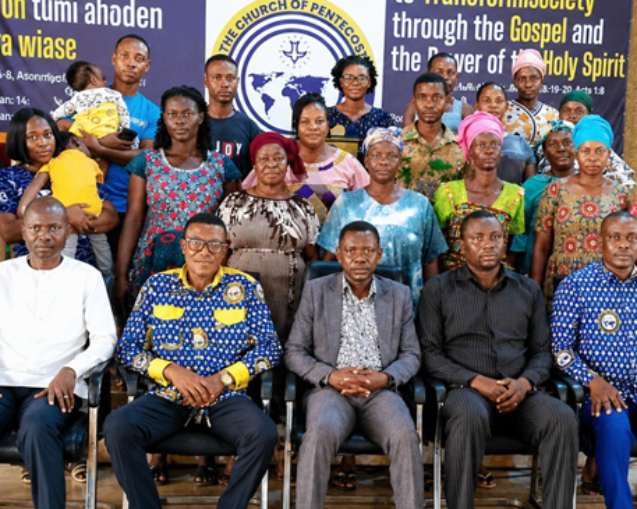



Lessons from the Just-Ended Pentecost Youth Mission
Luke 15:4 – “What man of you, having a hundred sheep, if he has lost one of them, does not leave the ninety-nine in the open country and go after the one that is lost, until he finds it?”
There are moments when God sends us into the field to preach to others, only for the field to preach back to us. The just-ended Pentecost Youth Missions in the Twifo Kyebi District was one such moment. We went out with the Gospel on our lips, expecting to encounter people who needed to hear about Jesus, but the mission brought us face to face with a painful reality: many of the souls we encountered were people who had once walked with Christ but had fallen away.
This should not leave us satisfied with the numbers recorded or the activities completed. It should leave us praying. It should drive the Church back to the altar with a question that cannot be answered casually: What is happening to the people we once gathered?
A soul does not usually wake up one morning and decide to abandon God completely. There is often a journey behind the departure. The fire begins to diminish. Prayer becomes a burden. The Word loses its sweetness. Fellowship becomes optional. An offence is preserved instead of forgiven. A wound is hidden instead of healed. A compromise is entertained instead of resisted.
Slowly, the heart moves before the feet ever leave the Church. Hebrews 2:1 therefore gives a solemn warning: “We ought to give the more earnest heed to the things which we have heard, lest at any time we should let them slip.” They slip — that is the language of Scripture. Sometimes there is no dramatic departure. There is simply a gradual drifting away.
And this is where the Church must look within. The inner court of the Church should be an abode of God’s presence and a covering for His people. David’s desire was, “that I may dwell in the house of the LORD all the days of my life” (Psalm 27:4). God’s house ought to be a place where a believer finds spiritual nourishment, fellowship, correction, encouragement and strength to continue the journey.
But if those who once dwelt among us are now scattered, we must prayerfully examine the environment we have created. Have our inner courts become places where people are strengthened, or places where wounds are multiplied? Have we made room for the struggling believer to seek help? Do our leaders and workers notice when someone begins to withdraw? Do we pursue those who disappear, or do we simply replace them and continue with the programme?
Ezekiel 34:4 presents a serious warning to shepherds: “The diseased have ye not strengthened, neither have ye healed that which was sick, neither have ye bound up that which was broken, neither have ye brought again that which was driven away, neither have ye sought that which was lost.” This Scripture places before the Church a ministry that cannot be neglected: strengthen, heal, bind, bring back and seek.
The backslider is not a statistic. The backslider is a soul. He or she has a name, a history, a family, a calling and a destiny. Behind the person who has stopped attending church may be a wound nobody noticed. Behind the person who no longer prays may be a battle nobody knew about. Behind the person who has returned to the world may be a heart waiting for somebody to come looking.
God’s attitude towards the backslider is beautifully captured in Hosea 14:4: “I will heal their backsliding, I will love them freely.” If God says, “I will heal,” then the Church must not merely ask why the person fell; we must also ask how we can help them rise.
The story of the prodigal son makes this even clearer. When he returned, his father did not stand at the gate rehearsing his failures. He ran towards him (Luke 15:20). Restoration was the father’s response to repentance. The Church must possess that same heart. Our inner courts must be places where the returning prodigal can encounter holiness without hypocrisy, correction without cruelty, and grace without compromise.
The mission has therefore exposed a gap that demands intentional action. Evangelism must not end when a person responds to an altar call. The work continues through follow-up, discipleship, fellowship, prayer, visitation and spiritual mentorship. Jesus told Peter, “Feed my sheep” (John 21:17). We cannot be passionate about bringing people into the Church while being careless about keeping them in the faith.
Our local churches must become places where people are known beyond their attendance numbers. Leaders must develop the spiritual sensitivity to recognise those who are drifting. Workers must learn to reach beyond programmes and into people’s lives. Members must be willing to call, visit, pray and stand with those who are struggling.
The Pentecost Youth Missions has reminded us that the harvest is not only the stranger we meet on the street. Sometimes, the harvest is the brother who once sat beside us, the sister who once served with us, or the young person who once burned for God but has quietly disappeared.
The mission may have ended, but another mission has become urgent: to recover the harvest within the harvest.
May our inner courts become an abode and covering for the lost, the weak, the wounded and the backslider, rather than a danger zone that pushes them further away.
Let us not only count those who have come. Let us go after those who have gone.
Written by Christian Entsie Adams (PIWC Dunkwa-On-Offin)