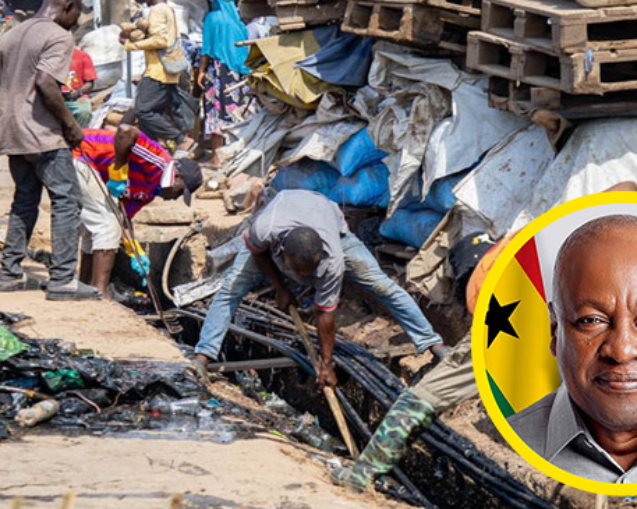



Ghana, our beloved motherland, is undeniably blessed with abundant natural and human resources. Accra, the capital, functions as the country’s economic center and attracts over 86% of all foreign direct investments. Sadly, the nation’s capital, which covers about 1.4% of the country’s land area, is plagued by ongoing flooding that dates back to the 1960s. Data shows that more than 150 people lost their lives in Accra during the flooding and fire disaster on June 3, 2015. Although the 2026 June rains have just begun, with more rainfall than usual expected, reports indicate that at least ten (10) people have died in Accra due to flooding and structural collapses. My deepest condolences and heartfelt sympathies go out to all who have been affected or have lost loved ones in these preventable events, which have nearly become an annual occurrence.
Some believe that humans have very little control over natural disasters, especially in low-lying areas like Accra. Of course, some disasters, such as certain tsunamis or hurricanes, surpass what engineering models can predict. For example, when God sent rain as a punishment during Noah’s time, no engineering model or concept could have prevented the damage caused by 40 days and nights of continuous rainfall. However, a clear distinction should be made between such divinely sent disasters and those that are self-inflicted. The ongoing flooding in Accra, along with its human and economic toll, cannot be categorized as “an act of God” or something outside human control.
Economic data I reviewed indicates that approximately $3.2 billion worth of assets in the Greater Accra Region are directly threatened by flooding. Meanwhile, as I mentioned earlier, God has blessed Ghana with some of the world’s brightest minds, leaders, engineers, sanitation experts, and urban planners. It is, therefore, not surprising that shortly after the June 3, 2015, flooding, a solution-finding committee issued all the recommendations necessary to reduce the adverse effects of the flooding menace in Accra. As we say locally here in Ghana, “We have the Men” to propose workable solutions for some of our most urgent challenges. This phrase clearly excludes any prejudice against some of our talented women who may have served on that committee and continue to shape the engineering landscape of our communities. Some of the major recommendations include desilting and dredging, expanding drainage, enforcing building codes, and ensuring permit compliance. Others are nature-based solutions, establishing micro-dumping sites, public sensitization, and relocating settlers in collaboration with the National Disaster Management Organization (NADMO), among others.
Interestingly, all of these are action-based recommendations for those entrusted with the authority and resources to implement them. Of course, attitudinal change among citizens, sustained campaigns by religious organizations, efforts by the National Commission on Civic Education (NCCE), and some Civil Society organizations can never be overlooked in reaching our goals. However, our biggest setback is over-reliance on Ghanaians’ patriotism to do the right thing—especially from those with the power to enforce it. Sadly, such warnings, encouragements, preachings, or sermons from those in authority have fallen on deaf ears for decades, and the problem seems to be worsening. This article examines the role of state power and authority in addressing human-caused challenges with serious national security implications. Ironically, each year’s Father’s Day coincides with the annual flooding season in Accra. Since men, or fathers, in every household symbolize leadership, power, and authority, efforts will also be made to remind all fathers of how God expects them to use the authority He has given them for the good of their families.
In the late 11th century BCE, a man named Eli was chosen by God to serve as the High Priest and Judge of Israel for 40 years. He was blessed with two sons, Hophni and Phinehas, who also served as priests at the Tabernacle in Shiloh. Beyond his role as a judge, Eli held significant power and authority as the head of his household. Strangely, Eli’s two sons began exhibiting behaviors unbecoming of priests of the Most High God. 1 Samuel 2:12 describes them as scoundrels who had no regard for the Lord. They showed contempt and callousness toward the sacrifices and offerings in the Temple and even went so far as to sleep with the women who served at the entrance to the tent of meeting. (1 Samuel 2:22)
The Israelites saw, heard, and began discussing the terrible deeds of Hophni and Phinehas, which nearly became a major topic across Israel. The citizens of Israel could do very little to stop these young men because they were not only priests, but their father was also the High Priest and the judge over all Israel at that time. The least one would expect from such a house of power and authority is to use all available means to call his two sons, who had become a disgrace among the Israelites, to account. Unfortunately, when the backlash from the citizens against his sons began, he went home, called them, and said, “Why do you do such things? I hear from all the people about these wicked deeds of yours. No, my sons, the report I hear spreading among the LORD’s people is not good.” He continued his sermon, “If one person sins against another, God may mediate for the offender; but if anyone sins against the LORD, who will intercede for them?” (1 Samuel 2:23-24). The scripture continues, “His sons, however, did not listen to their father’s rebuke…” Would it be out of place for a loving father to sit his children down and advise them, preach to them, or impress upon their conscience to do the right thing? Certainly not, since this approach has proven to be one of the best ways to curb deviant societal behavior. However, when he was not achieving the desired results, much more was expected from him as the custodian of the nation and the household’s authority and power.
Similarly, numerous environmental care and sanitation campaigns have been observed in recent years, not only in Accra but throughout Ghana. The Church of Pentecost, led by Apostle Dr. Eric Nyamekye, has allocated resources and launched sustained grassroots campaigns as part of their social and corporate responsibility to society, aligned with their Vision 2023 and 2028. Other professional bodies, such as the Ghana Institution of Engineers, Surveyors, Architects, Planners, and others in the built environment, have also been actively advocating, which I refer to as “The Sermon” for this discussion. Although many are beginning to recognize the harms of irresponsible attitudes toward the environment and water bodies, the country has yet to see the significant changes we expect, not only in Accra but nationwide. Furthermore, the organizations listed above lack prosecutorial and enforcement powers. Eli, however, was fortunate to be in a position to enforce discipline and bring his wayward children into order, as the entire security infrastructure was under his control.
After Eli failed God and the entire nation by the authority given to him as a father and leader of the nation, God visited him and said, “Why do you scorn my sacrifice and offering that I prescribed for my dwelling? Why do you honor your sons more than me…, Therefore, the God of Israel, declares: ‘I promised that members of your family would minister before me forever.’ But now the LORD declares: ‘Far be it from me! (1 Samuel 2:29-30). Wow! At this point, some could equally blame the young women serving as ushers or protocol officers in the Temple for the chaos in Shiloh, because they should have known better. However, God chose to remain silent about that. Isn’t that striking enough? Indeed, the servants who supported the foolishness of Hophni and Phinehas while the meat for the offerings was boiling could have also been charged with aiding their crime. Yet, the Lord chose not to speak about them or their families (1 Samuel 2:16). Even the entire congregation at the Temple of Shiloh could be blamed for not showing enough anger at the level of desecration carried out by Eli’s sons. Again, God didn’t direct His fury at the congregation. One last person who might also share some blame was Mrs. Eli. After all, as a mother, she saw and heard her sons’ folly and couldn’t do anything about it. However, God laid all the blame squarely on Eli, the High Priest and Judge, saying, “You failed to restrain your sons…”. (1 Samuel 3:13)
It is, therefore, instructive to learn that the power to restrain those misguided lusts of the flesh and eyes in His children resided with Father Eli. Several reasons have been given as to why the recommendations of the 2015 flood are yet to be implemented. Just as God expected Eli to do at home by cracking the whip instead of preaching to his children, God expects those in authority to crack the whip. Demolishing buildings on waterways, resettling petty traders, or enforcing any of the by-laws comes with its own backlash, especially in the context of our system of multi-party democracy. Based on the discussions so far, God expected Rev Eli to do the following beyond the usual preaching;
- Interdict and even prosecute Hophni and Phinehas when they start showing signs of sabotaging the Temple worship, peace, and overall national cohesion.
- Suspend and revoke the Ministerial or Priestly credentials from his sons to serve as a warning to citizens and as a lesson to all households.
- Hand over the priestly duties that his sons were performing to Samuel, who, as the Bible states, was young but maturing well and gaining support from all Israel from Dan to Beersheba. (1 Samuel 3:19). After all, Samuel was serving in the same temple as Hophni and Phinehas.
- Since private rebuke wasn’t working with his sons, God expected Eli to publicly condemn and distance himself from the ongoing desecration at Shiloh. Eli’s public posturing didn’t help, since society knew he was the one with the power to act. God judged his inaction as disrespecting Him at the expense of honoring his sons.
- As the one responsible, God expected Eli to deny his dishonorable sons all privileges, such as the best part of the Temple meat and other related Priesthood matters. That alone could have prevented them from having unrestricted access to the women who served at the Temple.
Similarly, much is expected from the government and officials with state authority to arrest, demolish, prosecute, fine, dismiss, demote, and protect society from a few stubborn individuals. State agencies need to go beyond preaching and take action, as there are already enough sermons from civil society and religious groups calling for attitudinal change. Rabindranath Tagore said, “You can’t cross the sea merely by standing and staring at the water.” It is also said that, “Iron is not molded by being talked about; it must be struck.” Some will always argue that the government of the day would be unpopular with the masses if the recommendations to curb flooding in Accra are implemented exactly as proposed. Eli could have also argued that taking action against his sons would have made him unpopular within his constituency. However, God showed him how He wanted him to restrain his sons when He caused both of his sons, his daughter-in-law, and himself to die on a single day. It is better to do the right thing for God and society, even when it threatens your electoral chances. Jesus once said in Matthew 10:39 (MSG), “If your first concern is to look after yourself, you’ll never find yourself. But if you forget about yourself and look to me, you’ll find both yourself and me.”
By June 2026, leaders in Australia, the UK, Malaysia, and Indonesia have all implemented bans or laws to restrict children under 16 from using major social media platforms. Denmark, Greece, and Austria’s bans are also scheduled to take effect in 2027, because if they do not use the authority given to them, their societies will fall apart before their eyes. These decisions will likely face backlash from the very people and households they seek to protect from cyberbullying, online predators, and mental health issues. Thank God, there are always action-oriented individuals in every society whose passion is to walk the talk, even when they have little power or authority. Kudos to such people in their homes, workplaces, and faith communities.
Around the 15th century BCE (that is, four centuries before Eli’s ministry during the time of the Judges), the first Phinehas, the grandson of Aaron the priest, took an action that earned God’s praise and saved an entire generation from perishing in the plains of Moab. At that time, Israelite men had begun engaging in sexual immorality with Moabite women and sacrificing to their idols as well. God became angry and sent a plague upon the Israelites. In a moment, the plague had killed 24,000 and was still spreading. As they wept and counted their losses, an Israelite man brought a Midianite woman into the camp right in front of Moses and the entire assembly at the entrance of the tent of meeting. “When Phinehas, son of Eleazar, the son of Aaron, the priest, saw this, he left the assembly, took a spear in his hand, and followed the Israelite into the tent. He drove the spear into both of them, piercing the Israelite man’s and the woman’s stomachs. Then the plague against the Israelites was halted; but those who died numbered 24,000.” (Numbers 25:7-9). Then the Lord said to Moses, “Phinehas, son of Eleazar, the son of Aaron, has turned my anger away from the Israelites. Since he was zealous for my honor among them as I am, I did not put an end to them in my zeal. Therefore, tell him I am making my covenant of peace with him. He and his descendants will have a covenant of a lasting priesthood…” (Numbers 25:10-12).
When Phinehas saw Zimri entering his tent with the Moabite woman Kozbi, he could have waited and preached to them afterward. He also could have ignored their immoral actions to keep his popularity among the Israeli men and foot soldiers. The action Phinehas took spoke louder than words, so much so that God heard him and immediately rewarded him. Incidentally, the Israeli man involved and the Midianite woman both had political connections within their respective societies. The man named Zimri was the son of Salu, who led a Simeonite family. The woman who was executed was Kozbi, also the daughter of Zur, a tribal chief of a Midianite family. Still, Phinehas, the action-oriented man, would not tolerate such insults to God, His chosen leaders, and Israel as a nation. Who said those connected to power and influence in society should not be touched? Once there is the will to act, Ghana, as a sovereign state, has the power to provide the solutions needed to address the ongoing flooding in Accra.
I would also like to remind parents in Ghana, especially fathers, on this Father’s Day to go beyond just preaching at home and to take the necessary actions, without fear or favor, for the betterment of the home and future generations. After all, fatherhood is not only about ruling or flaunting muscles over household members, but also about taking the necessary actions for the mutual benefit of the household, community, and the nation at large. Both Phinehas and Eli were leaders, but one acted with the authority entrusted to him, while the other only appealed to his sons’ consciences. In the end, God promised a covenant of peace and a lasting priesthood legacy to Phinehas’s household, but limited the promise to Eli, who refused to take action.
One phrase in God’s judgment against Eli’s household for refusing to act or restrain his sons was the approaching lack in his family members, who would come bowing before others and beg for a piece of silver and a loaf of bread to eat. (1 Samuel 2:36). There is an Eastern European proverb that says, “He who bakes through words alone will leave his family hungry.” Dear Fathers and Leaders, authority is for action, not for rhetoric or for relying on the conscience of the masses to determine what is right. Also, let us remember that on a set day of reckoning, we will all give an account for any power or authority delegated for our use, no matter how small. I trust God that none of us will be found wanting on that day. Stay blessed.
Written By Apostle James Orhin Agyin