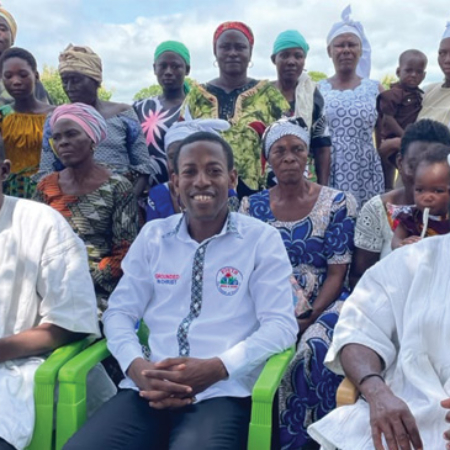



This topic deeply resonated with me during our commencement retreat, held from Friday, 25 September, to Sunday, 27 September 2026, at the Pentecost School of Theology and Mission (PSTM).
The topic, “An Unworthy Man Called by God,” reflects one of the profound realities of Christian ministry: God often calls people who recognise their own weaknesses, limitations and inadequacies. Scripture clearly demonstrates that God’s choice of His servants is not always based on human perfection, achievements or personal qualifications. Rather, He often calls ordinary and imperfect people, equips and qualifies them by His grace, and sends them out to fulfil His divine purposes.
Reflecting on this subject has challenged me to understand that no minister’s calling, including my own, is a reward for personal worthiness; rather, it is an expression of God’s grace and mercy. It also reminds me that God’s work does not depend solely on human strength. Instead, the Lord Himself chooses, equips, transforms and uses people according to His purposes and in His own time, all for His glory.
Recognising My Own Unworthiness
To describe myself as unworthy is not to suggest that I have no value. Rather, it is an acknowledgement that, as a human being, I have nothing to boast about apart from God’s grace and mercy, through which I have been saved. This awareness is essential for anyone who desires to serve God.
If I become overly confident in my abilities, knowledge, or achievements, I may begin to depend on myself rather than on God. For this reason, Proverbs 3:5 admonishes us to trust in the Lord with all our hearts and not to lean on our own understanding. When men called by God recognise their limitations, they are challenged to humble themselves and depend on the Lord for His grace. This also reminds me that whatever I accomplish in ministry is ultimately made possible by God’s grace.
Biblical Case Studies
Several people in the Bible recognised their weaknesses and inadequacies when confronted with God’s calling. Among them are Isaiah and Paul, whose experiences offer valuable lessons on the mystery of divine calling.
Isaiah: From Unworthiness To Availability
Isaiah’s experience deepens my understanding of what it means to be called by God. According to Isaiah 6:5, when Isaiah encountered the holiness of God, he became painfully aware of his own inadequacy and cried out, “Woe to me! I am ruined!”
Isaiah’s response demonstrates that an encounter with God’s holiness can produce a genuine awareness of human weakness and sinfulness. Yet God did not reject him because of his unworthiness. Instead, Isaiah was cleansed and prepared for service.
When God asked, “Whom shall I send? And who will go for us?” Isaiah responded, “Here am I. Send me!” (Isaiah 6:8). His experience reveals a significant transition: from recognising his unworthiness to making himself available for God’s service.
This challenges me to understand that recognising my weaknesses should not cause me to withdraw from God’s purpose. Rather, it should encourage me to depend more fully on Him, trusting that He is able to prepare and equip me for the task to which He has called me.
Paul: Transformed By Grace
The Apostle Paul presents another powerful example of divine calling. Before his conversion, Paul persecuted the followers of Christ. He later acknowledged his past and considered himself unworthy to be called an apostle because he had persecuted the Church of God (1 Corinthians 15:9).
Nevertheless, God’s grace transformed Paul’s life and gave him a new purpose. Recognising that his ministry was not the result of personal merit, Paul declared, “But by the grace of God I am what I am” (1 Corinthians 15:10).
Paul’s experience gives me hope because it demonstrates that God can transform a person’s life and turn it into a testimony of His grace. My failures and weaknesses may be real, but they do not have to determine my future. Through His grace, God can bring about transformation and give new meaning and direction to my life.
The Need For Continuous Growth
God’s calling does not eliminate the need for personal development. Rather, being called by God should inspire me to grow spiritually, intellectually, emotionally and relationally.
As someone preparing for ministry, I recognise the importance of prayer, the study of Scripture, theological education, practical experience, self-awareness and accountability. A minister cannot simply claim to be called by God while neglecting the character, knowledge and skills required for responsible service.
My interest in counselling psychology also reminds me of the importance of self-awareness and personal growth. A minister who understands his strengths, weaknesses, emotions and limitations is better equipped to relate to others responsibly and compassionately. Recognising my own humanity can help me become more empathetic towards the struggles and challenges of others.
Therefore, I must remain teachable, open to correction, and committed to lifelong learning. Divine calling is not an excuse for complacency; it is a responsibility that demands continuous growth and faithful service.
Humility In Ministry
Recognising that I am an unworthy man called by God should keep me humble. The ministry must never become a platform for personal pride, self-promotion or a sense of superiority over others.
If God chooses to use me, it is not because I am indispensable. He can accomplish His purposes through many people. My responsibility, therefore, is to remain available, obedient, and faithful to His calling.
This understanding protects me from becoming overly attached to titles, positions, achievements, or public recognition. Instead, it reminds me that the true foundation of ministry is humble service to God and humanity.
Ultimately, the mystery of divine calling lies in the fact that God, in His sovereignty and grace, chooses imperfect people and works through them to fulfil His perfect purposes. My unworthiness should not become an excuse for disobedience, nor should my calling become a reason for pride. Rather, I must continually depend on God’s grace, submit to His shaping, and remain faithful to the assignment He has entrusted to me.
May God grant us the grace to possess the nations and transform our world for His glory.
Written by P/Ovr. Benjamin Asamoah (PSTM 2026/2027 Cohort)